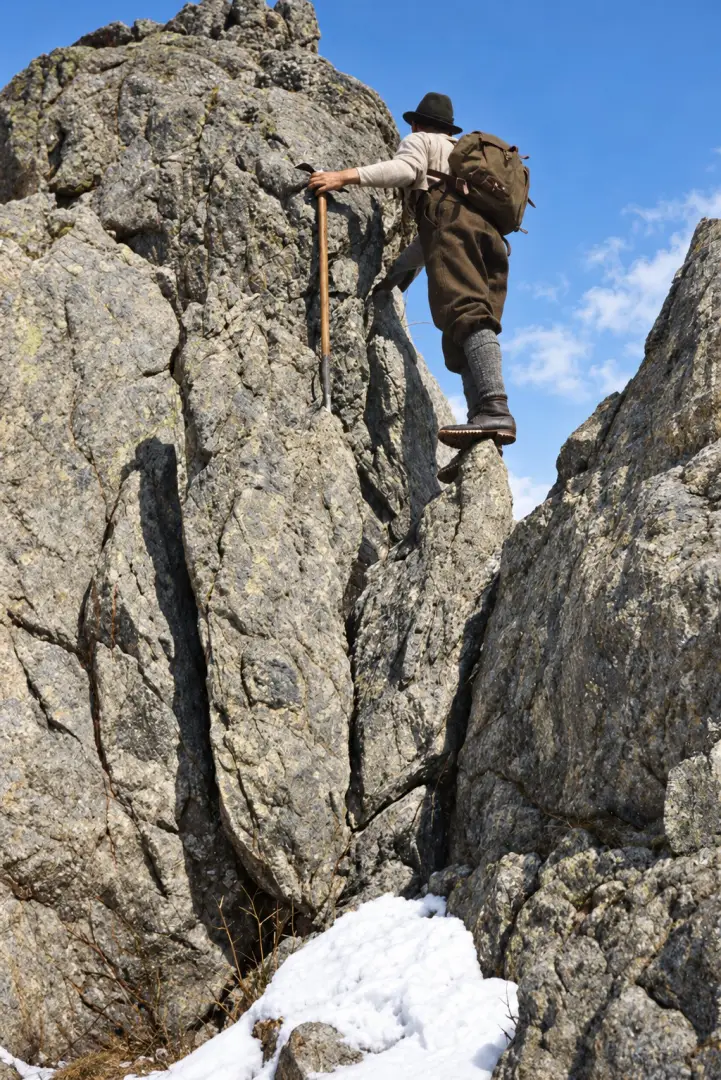

Edited by:
Massimo Martini
An engineer and mountaineer from Turin, a founding member of the Turin Ski Club and the Italian Academic Alpine Club.
Personal details
name: Adolfo Hess
born: 24 February 1878 – Turin
died: 8 June 1951 - Turin
Nationality: Italian
Occupation: electrical engineer
Affiliation: Italian Academic Alpine Club (founding member), Turin Ski Club (founding member)
Biography
Adolfo Hess was born in Turin on 24 February 1878, the son of Isidoro. He attended secondary school, spent two years at university and one year at the Turin School of Engineering, before going on to the Polytechnic and the Laboratory of Physics and Electrical Engineering in Darmstadt. He undertook practical training at the Bergmann workshops in Gaggenau, the Lahmeyerwerke in Frankfurt am Main, the Western Electric Company and the New Jersey Telephone Company in New York, where he was assistant to the engineer W. J. Hammer.
An electrical engineer, he was the proprietor of the firms Ingg. Hess & Perino, which operated in the field of electrical equipment and installations and in the trade of motor vehicles and accessories, and Ingg. Hess, Bonamico & Co., specialising in electrical equipment, machinery and installations, as well as the Impresa Elettrica Borgo Campidoglio in Turin. He founded the Società Chierese di Elettricità, which later became part of the P.C.E. and the S.I.P., and served on the board of directors of the P.C.E. In 1911, he was a member of the jury at theTurin International Exhibition; he gave lectures and wrote on radium, selenium, arc lamps, high voltage, heating and induction-based domestic appliances, citing his own patents in these works. From 1916 to 1918, as a captain in the Reserve Engineers, he served as an officer in the Procurement Directorate and the Technical Section of theAir Force and a member in Paris of the International Committee for the Standardisation of Aviation Materials; he also built an electromagnetic bomb-dropper of his own invention.
In the 1890s, he undertook his first ascents and, in 1896, marked the beginning of his own mountaineering and skiing training. He was one of the pioneers of skiing in Italy: he belonged to the first group of Turin-based skiers gathered around Adolfo Kind and wrote on the subject as early as 1899. On 21 December 1901, he was one of the twenty-nine founders of the Turin Ski Club.
His mountaineering activities took him to various parts of the Alps and focused on the Mont Blanc massif, where he took part in the systematic exploration of peaks and secondary routes that were still little known. He climbed both with guides and in rope teams consisting solely of mountaineers. On 5 April 1904, he was one of the sixteen founders of the Italian Academic Alpine Club, established within the Turin Section of the CAI to bring together and develop mountaineering without guides. He designed the association’s badge and, in 1926, succeeded Lorenzo Borelli as general president, a post he held until 1929, when he was succeeded by Umberto Balestreri. In an editorial in the 1924–1926 Yearbook, he addressed the question of what role the association might continue to play over time. His typewritten, undated curriculum vitae also lists his roles as councillor and vice-president of the Turin Section of the CAI, president of the CAI Recreational Gym, and editor of the magazine *Alpinismo*, as well as a gold medal of merit from the Turin Section.
He played a technical role in the establishment of permanent high-altitude bivouacs. The idea of constructing small prefabricated shelters for areas where it was not possible to build proper mountain huts was put forward by Lorenzo Borelli in 1923; a committee comprising Mario Borelli, Francesco Ravelli and Adolfo Hess developed the technical solution. The structures, built in the Ravelli brothers’ workshops from timber clad in sheet metal, were transported in sections and assembled directly at high altitude. An account published in 1953 by the CAI’s monthly magazine attributes to Hess the role of chief designer and builder, whilst in his own curriculum vitae he described himself as the inventor and builder of the CAI’s permanent bivouacs. One of the first two permanent bivouacs, the one at Col d’Estellette, was installed at the end of August 1925; the conception, design and construction are therefore credited to different individuals.
Alongside his mountaineering activities, he pursued writing, study, photography and music. He contributed to newspapers and magazines, including *La Stampa*, *Stampa Sera*, *La Gazzetta del Popolo*, *Torino Nuova* and *Augusta Taurinorum*; he gave lectures on mountaineering at the CAI branches in Turin, Biella, Milan and Genoa, and read his *Novelle alpine* at the CAI and the Circolo degli Artisti in Turin, where he played first violin in the orchestra. In the preface to *em* *Trent’anni di alpinismo* */em*, dated 1928, he urged young people to combine the speed of modern mountaineering with a touch of of the naivety and sentiment of the previous generation. He founded and chaired the CAI Photography Group, organised photographic exhibitions in Turin, Genoa and Rome and at the Circolo degli Artisti, and many of his photographs are preserved in the collections of the National Mountain Museum.
He helped organise the 1938 Turin Mountain Exhibition. From the 1930s until 1943, he was director of the Mountain Museum in Turin; he is credited with its refurbishment in 1939, prior to its reopening in 1942, and the systematic reorganisation of the photographic and iconographic collections, catalogued according to the names of the mountains and mountain ranges. He also worked on mapping Alpine routes for the Ministry of Popular Culture and on compiling records of Alpine municipalities for the Turin Provincial Tourist Board, and contributed to R. Chabod’s *Panorama delle Alpi dal Monte dei Cappuccini*.
In 1948, in Ceres, in the Lanzo Valley, where he spent periods of rest, he was caught in a snowstorm at Testa Paian, in the Val d’Ala; he fell and was almost buried by the snow; according to a report in a Turin newspaper from 1954, the rescuers reached him, guided by his dog Febo. He died in Turin on 8 June 1951, aged 73. He was the father of Guido Hess, a writer, poet and painter known by the pseudonym Guido Seborga.
Mountaineering achievements
Aiguille d’Entrèves – 1897 – first ascent, with Flavio Santi and the guide Proment
Aiguille de la Brenva – 1898 – first ascent
Dent du Jetoula – 1898 – first ascent
Grand Golliat (3,237 m) - 1898 – first ascent of the west face, exiting onto the north-north-west ridge, 15 July, with the guide Laurent Croux
South Peak of Mont de Rochefort – 1899 - first ascent
Aiguillettes du Tacul - ? - first ascent
Col du Diable - 1902 - first ascent
Pic de la Brenva - 1902 – first ascent
Mont Blanc du Tacul (4,248 m) - 1902 – first ascent via the south face, 3 September, with Agostino Ferrari, Flavio Santi and the guides Laurent Croux and Louis Mussillon; new route to Mont Blanc via the Gigante Glacier
Aiguille de Bionnassay (4,052 m) - 1907 – first Italian ascent without guides, 28 July, by Canzio, Mario Santi, Lampugnani, Guglielmina and Brofferio
Dames Anglaises – ? - reconnaissance and unsuccessful attempts
Places and names
Adolfo Hess bivouac (2,958 m) – Col d'Estellette, above the Lex Blanche glacier, Val Veny, Mont Blanc massif – named in 1951, following Hess’s death, by assembly resolution and on the proposal of Mario Santi
Works
New ascents in the Mont Blanc massif, Turin, G. U. Cassone, succeeded by G. Candeletti, [year to be verified]
Mont Blanc: ascent from the Colle del Gigante via the M. Blanc du Tacul summit and the M. Maudit Épaule, Turin, G. Candeletti Printing and Publishing House, 1898
Norwegian skis: their history, use and application, particularly in the military and mountaineering, Turin, Italian Alpine Club, 1899
The Black Forest and the Pale Group, Turin, Italian Alpine Club, 1901
Mont Blanc du Tacul: new ascents (with Agostino Ferrari), Turin, Italian Alpine Club, 1904
The Denti d’Ambin: ascents of the Tre Denti from Rocca d’Ambin via the ridge and the Savine face, Turin, Italian Alpine Club, 1909
Aiguille Noire de Pétéret, 3,780 m, Mont Blanc range, Turin, Italian Alpine Club, 1910
La Grande Casse (3,861 m), Turin, Italian Alpine Club, 1913
Essays on the psychology of the mountaineer: a collection of psychological autobiographies of living mountaineers, Turin, S. Lattes & C., 1914
A Brief Historical Overview of Mountaineering, Monza, Italian Workers’ Hiking Union, 1914
ThirtyYears of Mountaineering: in the Mont Blanc Range, Novara, Istituto Geografico De Agostini, 1928
Tourist Guide to Mountaineering and Skiing in Piedmont, Turin, Provincial Tourist Board, 1938
In memory of Dr Flavio Santi, mountaineer and botanist (with Enrico Mussa), 1939
Mountain Tales, [place and publisher to be verified], 1949