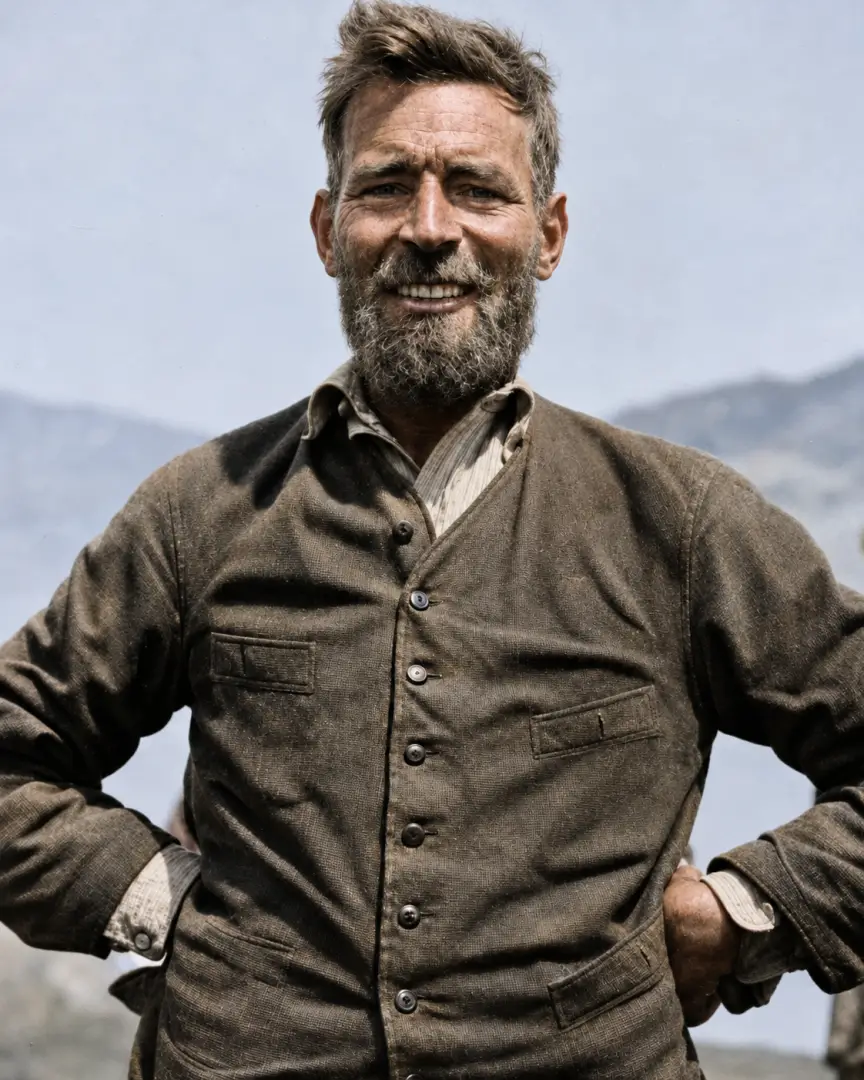

Edited by:
redazione
Geologist and mountaineer, leader of the 1930 international expedition to Kangchenjunga and the 1934 expedition to the Karakorum.
Personal details
Name: Günter Oskar Dyhrenfurth
Date of birth: 12 November 1886 - Breslau (now Wrocław, Poland)
Died: 14 April 1975 - Ringgenberg (Canton of Bern, Switzerland)
Nationality: German, later Swiss
Occupation: geologist, mountaineer, explorer, university lecturer
Affiliation: Austrian Alpine Club
Biography
Günter Oskar Dyhrenfurth was born on 12 November 1886 in Breslau, then a city in the German Empire and now Wrocław, in Poland. In the history of mountaineering, he is associated with two international expeditions to Asia, which he organised and led in the 1930s, and with a series of comprehensive books on the eight-thousanders; throughout his life, he combined geological research with mountaineering.
He studied geology and palaeontology in Freiburg im Breisgau, Vienna and Breslau between 1904 and 1909 and soon began working in the field: from 1907 to 1914 he took part in the survey for the Geological Map of Switzerland in the Grisons, an area to which he dedicated his study on the Engadine Dolomites, published in 1913, the year he obtained his habilitation. In 1911, he married Hettie Heymann, also from Wrocław, with whom he had three children: Harald, Hiltraut and Norman. At theUniversity of Breslau, he was a full professor from 1919 to 1921 and an associate professor of geology and palaeontology from 1921 to 1933. In the 1920s, the family lived in Salzburg and later moved to Switzerland, to the Lake Brienz area.
Alongside his teaching, he pursued an extensive mountaineering career, completing around sixty first ascents of European mountains with companions such as Oskar Schuster, Gustav Jahn and Emil Meletzky. He was a member of the Österreichischer Alpenklub for almost seventy years.
In 1930, he led the international expedition to the Kangchenjunga and, in 1934, the expedition to the Upper Baltoro Glacier in the Karakoram, aimed specifically at exploring Gasherbrum I and Gasherbrum II. Hettie took part in both as a mountaineer. In 1934, the plan changed whilst in the field: having reached 6,200 metres on the south-south-east spur, the team judged it impossible for the Balti porters to continue along the steep snow ridge and shifted theactivities to the nearby peaks of Sia Kangri and Baltoro Kangri. Among the members of that expedition was the Italian Piero Ghiglione.
Documentation was an integral part of both projects. In 1930, footage was shot for the first time at altitudes above 6,000 metres: the material, filmed by Charles Duvanel, was incorporated into the documentary *Himatschal, der Thron der Götter*, released in 1931. Footage from 1934, shot by Richard Angst and Hans Ertl, amongst others, was used in the feature film *Der Dämon des Himalaya* (1935), starring Gustav Diessl. The expedition reports contained observations on geology and glaciology and contributed to the first scientific understanding of the tectonics of the Himalayas.
After the National Socialists came to power in 1933, he resigned from his professorship in Breslau. He obtained Swiss citizenship, with ties to Wassen, in 1932 or 1933: sources disagree on the year. At the 1936 Berlin Games, the Olympic mountaineering prize was awarded jointly to him and Hettie for their expeditions in 1930 and 1934; this was recognition for achievements already made, rather than a competition held during the Games. At the same Games, he also took part in the literary competition, in the epic works category.
From 1935, Hettie gave a series of lectures in the United States and eventually settled there, whilst Dyhrenfurth remained in Switzerland. Her son Norman joined her in 1937 and did not see his father again until 1952. The divorce took place in 1948; in the same year, Dyhrenfurth married Irene, a literary scholar and mountaineer.
From 1939 to 1954, he taught geography and natural sciences at theRosenberg Institute in St Gallen and, during those years, devoted himself to the historical reconstruction of Himalayan mountaineering, writing books on the eight-thousanders, Nanga Parbat and Kangchenjunga. In 1956, he was rehabilitated as a victim of Nazism, with retroactive appointment as full professor and professor emeritus, and was awarded the Order of Merit of the Federal Republic of Germany.
The first ascent of Gasherbrum I, achieved in 1958 by a US expedition, followed the IHE Spur, which takes its name from the 1934 international expedition and on which that expedition had attempted the climb. His son Norman led the US expedition to Everest in 1963. Günter Oskar Dyhrenfurth died in Ringgenberg, in the canton of Bern, on 14 April 1975. His story and that of his son form the focus of the documentary *Zum dritten Pol* (2007).
Mountaineering achievements
Laaser Wand, north ridge - 1918 – first ascent of the route, with Emil Meletzky and Alfons Kasseroler
Sella Tower (2,688 m), Sella Group – first ascent from the south-west, with Gustav Jahn and Emil Meletzky – year not documented
International expedition to Kangchenjunga, Eastern Himalayas – 1930 – expedition leader; main objective not achieved; ascent of Jongsong Peak (7,459 m or 7,462 m depending on the source) by members of the expedition, at that time the highest peak ever climbed
international expedition to the Upper Baltoro Glacier, Karakorum (now Pakistan) – 1934 – expedition leader; exploration of the Gasherbrum massif with an attempt on Gasherbrum I via the south-south-east spur up to 6,200 m; first ascents of seven-thousanders in the Karakoram
Sia Kangri – 3 August 1934 – with Hettie Dyhrenfurth, Hans Ertl and Albert Höcht; the summit reached is referred to in sources as either the main peak (7,422 m) or the western peak (7,315 m); with this ascent, Hettie Dyhrenfurth surpassed Fanny Bullock Workman’s 1906 record for thealtitude set by Fanny Bullock Workman in 1906
Mont Blanc massif – 1937 – seven peaks over 4,000 m during a singlesingle expedition, with her son Norman
Works
Die Engadiner Dolomiten, 1913
Himalaya. Unsere Expedition 1930, Berlin, Scherl, 1931
Dämon Himalaya. Report of the International Karakoram Expedition 1934, Basel, Schwabe, 1935
Baltoro. A Book on the Himalayas, Basel, Schwabe, 1939 (with contributions by Hettie Dyhrenfurth and others)
Himalayan Expedition. Our 1930 Expedition, Zurich, Orell Füssli, 1942
To the Third Pole. The Earth’s Eight-Thousanders, Munich, Nymphenburger Verlagshandlung, 1952
The Book of Nanga Parbat. The History of its Ascent 1895–1953, Munich, Nymphenburger Verlagshandlung, 1954
The Book of Kantsch. The History of its Ascent, Munich, Nymphenburger Verlagshandlung, 1955
The Third Pole. The Eight-Thousanders and their Satellites, Frankfurt am Main, 1961
Bibliography
As a writer
no critical study dedicated to his written works has been found
As a key citation
Anders Bolinder, Professor Günter Oskar Dyhrenfurth, in *Die Alpen* 33, 1975
The Dyhrenfurths, exceptional figures in the history of Himalayan mountaineering, Rivista della Giovane Montagna