
Edited by:
redazione
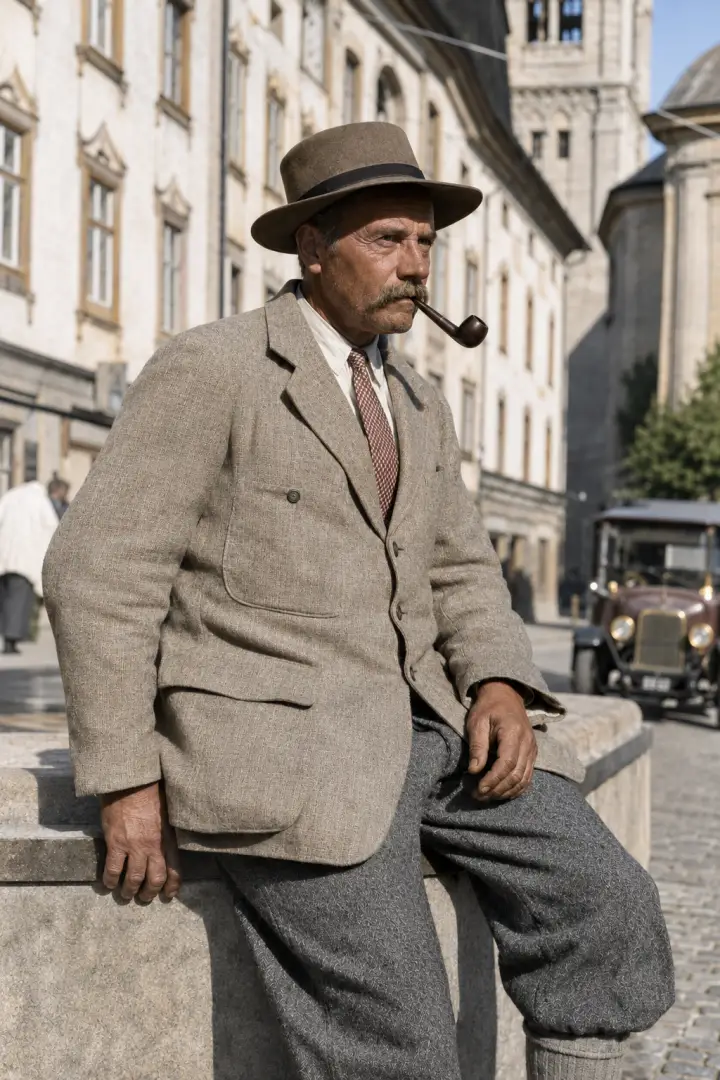
Mountain guide from Cortina d’Ampezzo (1879–1956), known as Pilato. Between 1908 and 1913, he opened new routes in the Dolomites, the Karwendel, the Dauphiné and the Mont Blanc massif; a peak in the Écrins bears his name.
Personal details
name: Angelo Dibona
date of birth: 7 April 1879 – Cadìn, Cortina d’Ampezzo
Died: 21 April 1956 – Cortina d’Ampezzo
Nationality: Austro-Hungarian, later Italian
Occupation: mountain guide and ski instructor
pseudonym / nickname: Pilato
Biography
Angelo Dibona was born on 7 April 1879 in Cadìn, a hamlet of Cortina d'Ampezzo, to Luigi Dibona and Veneranda Dimai. His maternal grandfather, Angelo Dimai, was a mountain guide and had taken part in the pioneering phase of mountaineering in the Dolomites. As a young man, Dibona worked as a shepherd in the Ampezzo mountain pastures. Cortina was then part of the Austro-Hungarian Empire, and it was within that system that he entered the profession: in 1905 he was registered as a porter, with the title of ‘Träger’, and on 22 July 1907, after a course in Villach, he received his mountain guide’s licence. In 1911, he was among the first ski instructors in Cortina, alongside Celestino De Zanna and Bortolo Barbaria.
From 1909, his work was linked to that of Luigi Rizzi, a guide from Campitello di Fassa, and the Viennese brothers Guido and Max Mayer. His relationship with the Mayers began as that between guides and clients, but developed into a friendship that allowed Dibona the freedom to choose his own routes. Over four seasons, the climbing team opened routes on large rock faces in very different environments: the limestone of the Dolomites and the Karwendel, and the granite and mixed terrain of the Dauphiné and Mont Blanc. In 1913, with Guido Mayer, Dibona was the first to climb a spire in the Écrins then known as the Pain de Sucre du Soreiller, which was later named after him.
On the rock face, he preferred free climbing and distinguished between pitons used for protection and those used as a means of progression, resorting to the latter as little as possible. Accounts agree on the small number of pitons used on his routes, but not on the exact total. Even the difficulty ratings of his most challenging ascents vary depending on the source.
During the First World War, he served in the Austro-Hungarian army. After the war, with Cortina having passed to Italy, he resumed his work as a guide. Between 1932 and 1933, aged over fifty, he returned as lead climber on two routes he had climbed in his youth, on the Ödstein and the Cima Una. In 1944, aged 65, he opened yet another new route in the Cristallo massif, roped up with Severino Casara, Luis Trenker and others.
In 1930, he wrote an autobiographical account, published in 1951 by the magazine *Berge*. He died in Cortina d’Ampezzo on 21 April 1956, aged 77. In 2006, fifty years after his death, theUnion de i Ladis de Anpezo published a volume dedicated to him, edited by Carlo Gandini, and the Gruppo Scoiattoli di Cortina promoted a documentary produced by Francesco Mansutti and Vinicio Stefanello.
Mountaineering achievements
Roda di Vaèl – 1908 – first ascent of the west face via the Parete Rossa route, Catinaccio
Cima Grande di Lavaredo - 1909 – ascent of the north-east ridge, with Emil Stübler; the route is named after Dibona, but there is a record of a possible solo ascent by Rudi Eller in 1908
Cima Una – 18 July 1910 – first ascent of the north face, Sesto Dolomites, with Luigi Rizzi and Guido Mayer; one source also includes Max Mayer in the rope party
Croz dell’Altissimo – 16 August 1910 – first ascent of the south-west face, Brenta Dolomites, approximately 1,000 m in length, with Luigi Rizzi and Guido and Max Mayer; difficulty rated V+ or VI depending on the account
Lalidererwand – 18–19 August 1911 – first ascent of the north face, Karwendel, Austria, with a bivouac on the face, with Luigi Rizzi and Guido and Max Mayer
Meije (3,983 m) - 28 July 1912 – first ascent of a route on the south face, the Mayer-Dibona route, Dauphiné, France, with Luigi Rizzi and Guido and Max Mayer
Aiguille Dibona, then known as Pain de Sucre du Soreiller - 27 June 1913 – first ascent via the north ridge, Écrins, France, with Guido Mayer
Ailefroide Centrale - 1–2 July 1913 – ascent via the north ridge of the Coste Rouge, Écrins, France
Dôme de Neige des Écrins – 14 July 1913 – ascent of the north-west face, Écrins, France
Aiguille du Plan – 18 August 1913 – ascent of the south-east ridge, Mont Blanc massif
Dent du Requin – 22 August 1913 – ascent of the east-north-east ridge, Mont Blanc massif
Petites Jorasses - 26 August 1913 – ascent from the south-west, Mont Blanc massif
Ödstein – 1932 – north-west arête, as lead climber, on a route he had previously climbed in his youth, Gesäuse, Austria
Cima Una – 1933 – north face, as lead climber, on the route first ascended in 1910
Punta di Michele – 28 July 1944 – first ascent of a route on the north-west face, Cristallo massif, with Severino Casara, Luis Trenker, Otto Menardi and Walter Cavallini; the last new route credited to him
Places and commemorations
Angelo Dibona mountain hut (2,083 m) – Valon de Tofana, Cortina d’Ampezzo – at the foot of the Tofane
Piazza Angelo Dibona – Cortina d’Ampezzo – featuring a bronze bust by the sculptor Augusto Murer, dating from 1976
Aiguille Dibona – Écrins massif, France – formerly known as Pain de Sucre du Soreiller, named after the first ascent in 1913
Works
autobiographical account, written in 1930, published in the magazine Berge, June 1951
Bibliography
As a writer
no documented study dedicated to his written work
As a significant reference
Carlo Gandini (ed.), From Cortina d’Ampezzo to the Alps. Angelo Dibona, mountaineer and guide, Union de i Ladis de Anpezo, 2006