Nus Parish Church

Edited by:
redazione
Access
Access
Drive to the village centre of Nus and park near the church, in the centre of the village. Alternatively, travel to the village by public transport and complete the journey on foot.
Driving directions
Leave the motorway exit at Nus and continue north-east for 220m (220m), then at the roundabout take the first exit onto the Fénis regional road. After 600m (820m), at the roundabout, take the third exit and continue on the for 97m (917m) and for a further 900m (1.8km). Take the towards Via Augusto Pramotton Prieur: turn right onto Via Champagne for 71m (1.9km), turn right onto Via Aosta () for 160m (2.0 km), turn left onto Via St. Barthelemy () for 450 m (2.5 km) and turn left onto Via Augusto Pramotton Prieur. The church is on the left after 58m.
Car park
There is a free 🅿️ car park near the church.
Access by public transport
Nus railway station is on the Aosta–Turin line and is about a 10-minute walk from the church, through the centre of the village. The town is served by regional buses connecting Aosta and other towns in the Aosta Valley, with stops in the centre; the church is within walking distance of the bus stop.
🕒 Journey time: 4 minutes
📏 Distance: 2.5 km
GPS navigation
Important information
The directions provided were verified on the date the route was mapped. Before setting off, we recommend checking for any changes to the route or road conditions. For up-to-date information, please consult Google Maps or Apple Maps.
Introduction
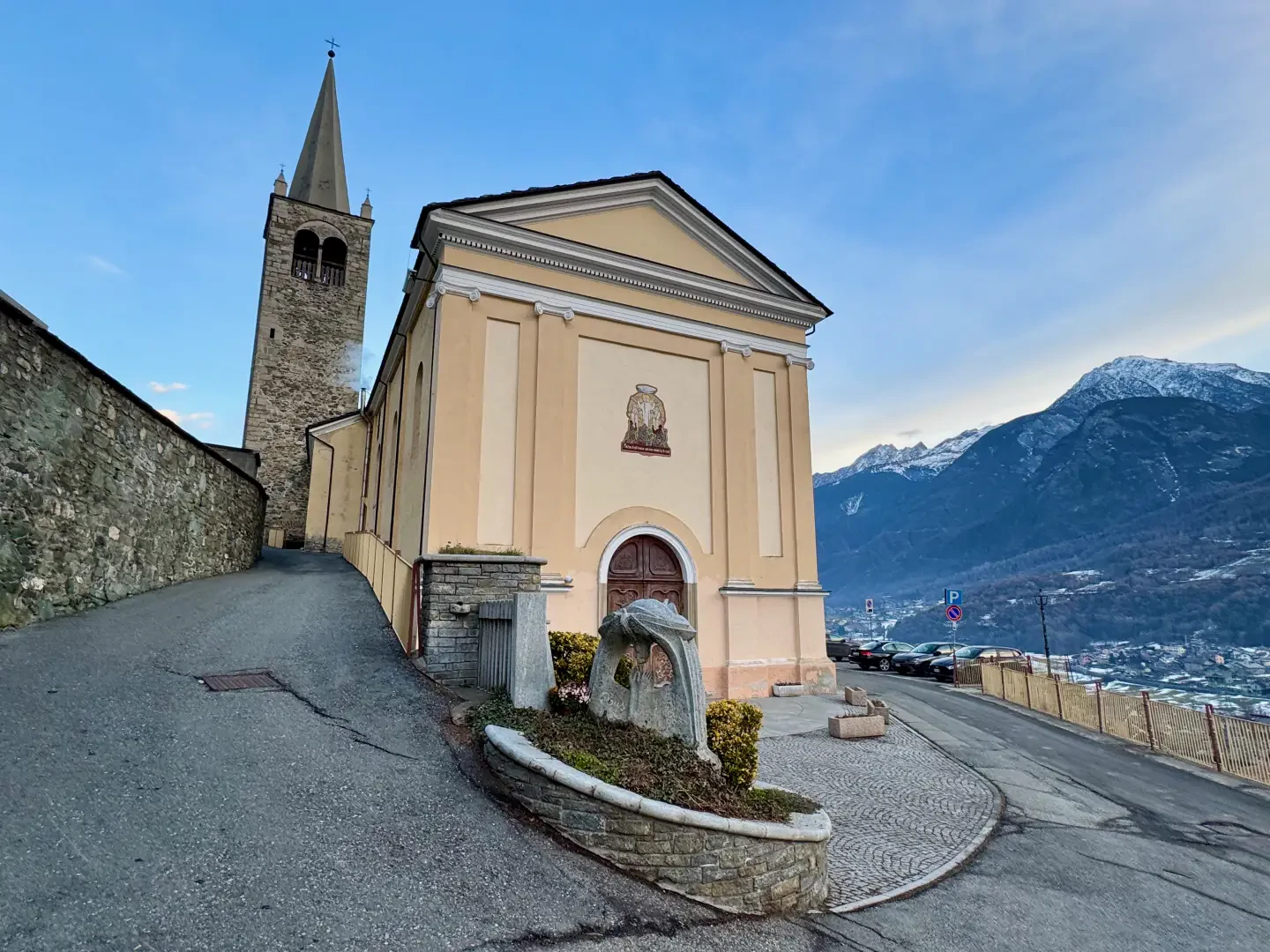
The parish church of Nus, dedicated to Saint Hilarion of Poitiers, stands in the main town of the municipality of Nus, in the middle Aosta Valley, at an altitude of 529 metres. It is the parish church of the municipality, which in the Middle Ages was under the authority of a prior attached to the Benedictine Abbey of Ainay, near Lyon. For centuries it remained linked to the parish of Saint-Barthélemy, which was under the authority of the same prior and did not have a parish priest of its own. The present building is a nineteenth-century structure erected on the site of an older medieval church.
Description
The first documented mention of the parish of Sant’Ilario dates back to 26 February 1153, when a papal bull issued by Pope Eugene III listed the church of Nus amongst the Aosta Valley possessions of the Abbey of Ainay, alongside those of Quart, Saint-Barthélemy and Saint-Vincent. Pastoral care was entrusted to secular priests under the authority of the Bishop of Aosta. The parish of Saint-Barthélemy remained united with that of Nus until 26 September 1746, when it was established as an independent parish. The link with Ainay ended in 1588: on 20 April, Pope Sixtus V assigned the rights to the priory of Nus to the Dominicans of the Holy Office in Vercelli. From 1755, the parish came under the direct authority of the Bishop of Aosta.
Archaeological excavations in 1990 brought to light, beneath the chancel, part of the 12th-century Romanesque church, comprising three naves ending in a larger central semicircular apse and two lateral apsidioles. In the 15th century, the church was altered: the apses were demolished and the chancel was extended into a rectangular shape. The bell tower is also attributed to the 15th century; it follows a style common in the Aosta Valley, examples of which include the bell towers of Fénis and Saint-Germain.
In 1884, the parish council resolved to rebuild the church. The project was entrusted to Giuseppe Lancia and work began in 1886. The building was completed in 1887 and consecrated on 12 April 1888. It has a single nave in the form of a Latin cross, covered by ribbed vaults, with a dome over the chancel. The façade is in the Neoclassical style, with four pilasters featuring Ionic capitals and a triangular pediment. Inside, half-columns with composite capitals support a moulded cornice.
The high altar and the altar of St Joseph were rebuilt by the sculptor Guala. An early phase of the nineteenth-century pictorial decoration is the work of the Artari painters. In 1959, Luciano Bartoli painted the frescoes in the choir, on the walls of the chancel and in the niche housing the baptismal font, depicting the Holy Trinity, the Virgin Mary, Saint Hilarion and scenes from his life. To the left of the choir stands a medieval wooden crucifix. Also preserved are a Way of the Cross and a canvas depicting the Holy Trinity, the Virgin Mary, Saint Joseph and other saints, dating from the 18th–19th centuries.
Part of the masonry of the medieval church is visible in a space created beneath the choir. In the 20th century, the floor of the nave was replaced. In 2014, work was carried out on the roof, the stained-glass windows, the pinnacles and the clock on the bell tower; in 2020, the flooring, heating, lighting and sound systems, and part of the liturgical furnishings were renovated.
Information
Opening hours: The Church of Sant’Ilario is generally open during liturgical services and at specific times set aside for visitors. Opening times may vary depending on the season or specific events, so it is advisable to contact the parish office in Nus or check the local noticeboards for updates.
Related events: The parish of Sant’Ilario regularly hosts liturgical services, concerts of sacred music and events linked to local traditions. One of the main celebrations is the patron saint’s day of Sant’Ilario, held on 13 January, featuring religious services and community gatherings. Themed guided tours and cultural events may also take place throughout the year.
To ensure a pleasant and well-organised visit, it is always a good idea to plan your trip by checking information on timetables and events in advance via the official channels of the parish or the municipality of Nus.
General information
Type: places of worship, churches
Other names: Parish Church of Sant’Ilario, Church of Sant’Ilario
Period: 12th century (first documented mention, 1153); 19th century (reconstruction, 1886–1887)
Style: Neoclassical (façade)
Dedication: SaintIlario of Poitiers
Patron saint’s day: 13 January
Altitude: 529 m
Location: main town
Municipality: Nus
Valley: middle Aosta Valley
Region: Aosta Valley
Country: Italy
Diocese: Aosta
Aosta
Country: Italy
Diocese: Aosta