Vatican City

Edited by:
Massimo Martini
Access
Vatican City is enclosed in the urban fabric of Rome, with direct access via the main transport carriers serving the Italian capital. Rome Fiumicino International Airport (FCO) is the main hub, about 30 km from the Vatican; Rome Ciampino Airport (CIA) serves mainly low-cost carriers. From Fiumicino, the connection to the centre of Rome is via the Leonardo Express train (30 minutes) to Termini station, from where the metro line A (Ottaviano-San Pietro or Cipro stop) reaches the Vatican. Metro line A is the most direct connection from Termini station to the entrance of the Vatican Museums. ATAC trams and buses complete the urban transport network. Vatican City does not have its own publicly accessible railway station (the inner track is used exclusively for logistical supplies); it has no airport or port. The border crossings into the state are guarded by the Vatican Gendarmerie and the Pontifical Swiss Guard. To visit the Vatican Museums and St. Peter's Basilica advance booking is generally required, particularly during peak tourist seasons (April-October, Holy Week, Christmas).
Introduction
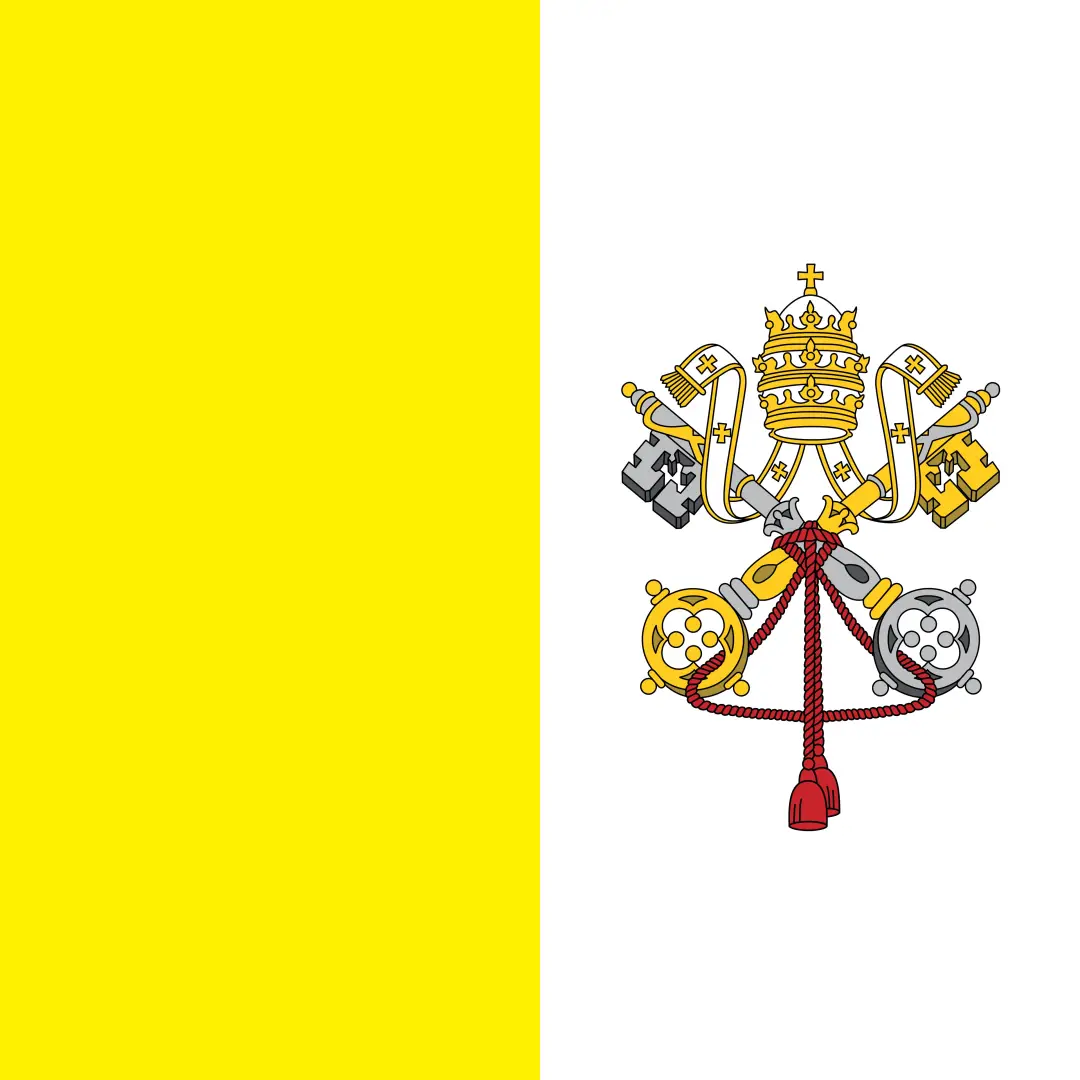
Vatican City State - officially the Vatican City State - is the smallest sovereign state in the world in terms of area (0.44 km²) and population (approximately 800-900 inhabitants), embedded in the urban fabric of Rome on Vatican Hill. It is an absolute elective monarchy, governed by the Supreme Pontiff of the Catholic Church, who is both head of the Vatican State and head of the Holy See - the two distinct legal entities coexisting in this territory. The State came into being on 7 June 1929 with the Lateran Pacts, signed between the Holy See and the Italian government represented by Benito Mussolini, putting an end to the so-called Questione Romana opened in 1870 with the conquest of Rome by the Kingdom of Italy. The Vatican is internationally recognised and maintains diplomatic relations with almost all states in the world; the Holy See has permanent observer status at the United Nations. It is the only state in the world to be inscribed in its entirety on the UNESCO World Heritage List.
.Description
The territory of Vatican City is roughly trapezoidal in shape and covers an area of 0.44 km²: about one third is occupied by the Vatican Gardens, the rest by buildings, courtyards, squares and infrastructure. The boundaries are delimited mainly by walls built in several phases between the 9th and 17th centuries (Leonine Walls, Urban VIII Walls); on the St. Peter's Square side, the boundary is traced by a band of travertine basalt tiles that joins the two arms of the Bernini colonnade. The Vatican citizenship is temporary and functional: it is granted for the duration of the relationship with the State and is lost when the office is terminated.
The Vatican City State does not coincide with the Holy See, which is the ecclesiastical governing entity of the Catholic Church, present internationally as a subject of law before and independently of the existence of the territorial state. The history of the papal temporal power dates back to the 8th century, with the Donation of Pippin (754 A.D.), which gave the papacy control over large regions of Italy; the Papal States survived for over a millennium until the taking of Rome on 20 September 1870. During the so-called "prisoner of the Vatican" (1870-1929), the popes refused to recognise the legitimacy of the Kingdom of Italy and refrained from leaving the Vatican borders. The Lateran Pacts of 1929 defined the territory of the State, the mutual recognition between the Holy See and Italy, and the financial endowment that still contributes to the sustenance of the Vatican administration.
The artistic and architectural heritage preserved in this small area is among the densest in the world. St. Peter's Basilica, designed by Bramante, Michelangelo, Maderno and completed by Bernini's colonnade (17th century), is the largest church in Christianity. The Vatican Museums - a complex of about 54 galleries and rooms - contain among their most important works the Sistine Chapel, with the fresco cycle of the vault (1508-1512) and the Last Judgement (1536-1541) by Michelangelo; Raphael's Rooms (1508-1524); the Picture Gallery with works by Giotto, Leonardo, Caravaggio and Titian; the Gallery of Maps; and the Egyptian, Etruscan, Greek and Roman collections. The Vatican Gardens (23 hectares) contain structured vegetation with historic trees, fountains and sculptures. The Pauline Chapel, the Apostolic Palace and the Vatican Library - with over 1.1 million volumes and 75,000 manuscripts - complete the state heritage.
The Vatican economy is based on the offerings of the faithful (St. Peter's Obolus), revenues from the Vatican Museums (among the most visited tourist sites in Italy, with over 6-7 million visitors per year in normal periods), returns from real estate managed by the APSA (Administration of the Patrimony of the Apostolic See), publishing rights and philatelic and numismatic issues. Vatican City adopts the euro as its currency, mints its own coins with the papal effigy and produces its own stamps, which are coveted by collectors. The state has a radio station (Radio Vaticana, since 1931) and a daily newspaper (L'Osservatore Romano, since 1861).
Not being a natural territory, the Vatican has no hiking or mountaineering facilities. Visiting the Vatican Gardens - accessible by guided tour with prior booking - is the only way to enjoy a green space within the State. Trail running and hiking in the proper sense are not applicable.
.Information
General Data
Capital: Vatican City
Area: 0.44 km²
Minimum elevation: 19m
Maximum elevation: about 75m (Vatican Hill)
Number of inhabitants: 882 (Wikipedia IT data)
Official name: Status Civitatis Vaticanæ
Name of inhabitants: Vatican
Border countries: Italy
Institutional website: https://www.vaticanstate.va