Bard Fortress

Edited by:
Massimo Martini
Access
The Fortress is reached from the centre of the medieval village of Bard (AO), along Via Vittorio Emanuele II. From the main square, you can ascend on foot via a paved pedestrian path, or use the panoramic lifts that connect the various terraces of the complex.
Access is easy and suitable for everyone, thanks also to services for persons with reduced mobility. For those arriving by car, a car park is available in the valley, connected to the fort by a system of escalators and lifts. Alternatively, the visit can be included in a hiking itinerary along the Via Francigena or other routes in the lower Aosta Valley.
Introduction
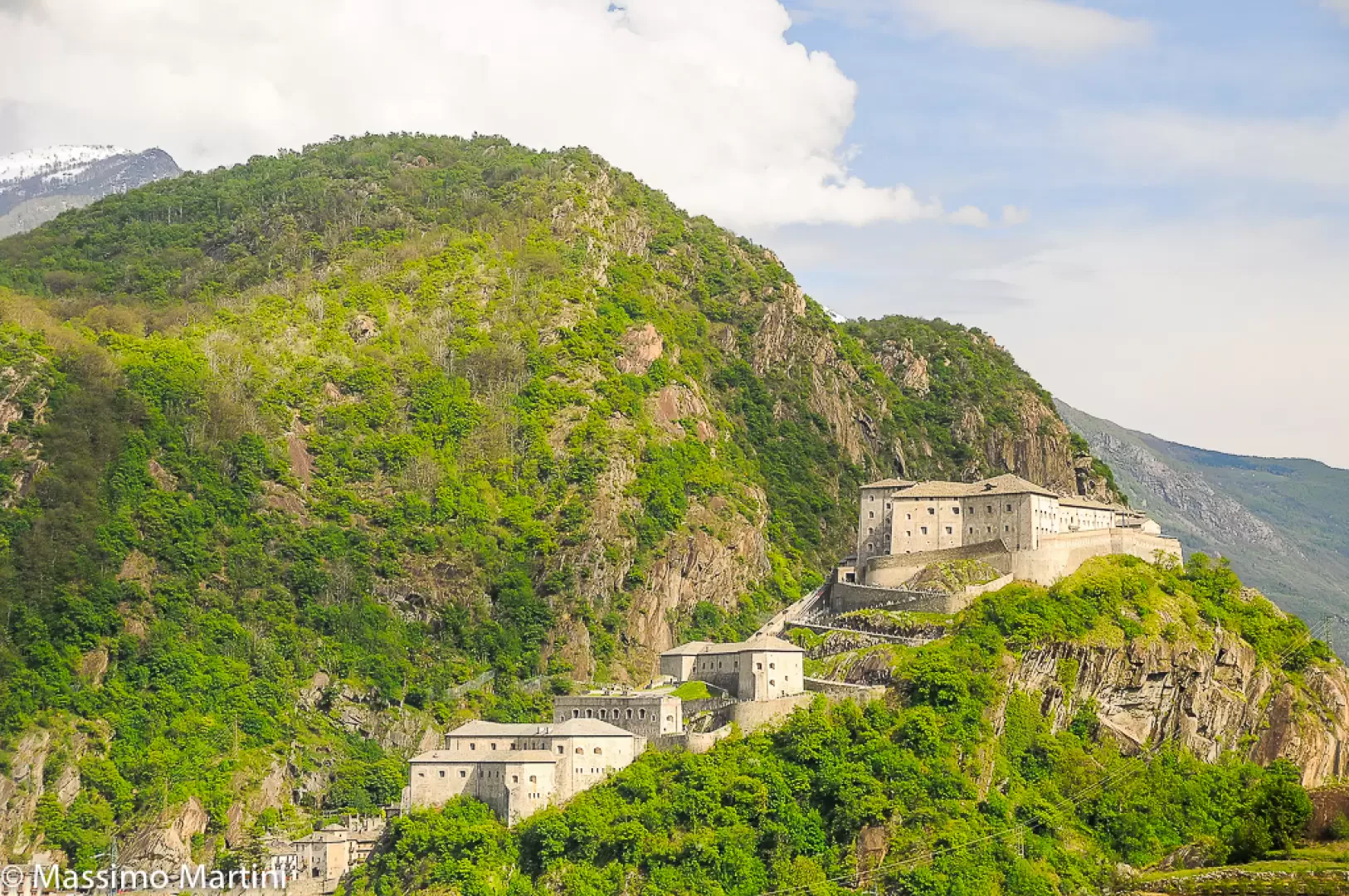
Perched on a rocky spur dominating the entrance to the Valle d'Aosta, the Fortress of Bard stands out with its compact and silent mass. Now restored and enlivened by new cultural functions, this place preserves intact the symbolic power of a sentinel of Alpine history. To visit it is to ascend not only physically, but also in time.
Description
The Fortress of Bard, or Fort de Bard in French, is a fortified complex rebuilt between 1830 and 1838 at the behest of the House of Savoy, after Napoleon Bonaparte ordered its destruction in 1800, during his descent into Italy. The military engineer Antonio Francesco Olivero was commissioned to design the new fort, which was to meet the defensive needs of the time, but also to enhance Bard's strategic position, an obligatory passageway for those travelling through the valley.
Constructed with stone and concrete ashlars, the fort is divided into several buildings distributed in terraces, overlooking the village. After a long period of abandonment, culminating in the 20th century, it underwent a thorough conservative restoration that restored dignity and function to every part of it.
Since 2006 it has been open to the public again and hosts temporary and permanent exhibitions. These include the Museum of the Alps, with a multimedia exhibition on the mountain and its cultures, and the route through the old prisons, which preserves the original charm of the places. The fort is now also a venue for cultural, educational and sporting events that keep the dialogue between past and present alive.