Hermitage of Camaldoli

Edited by:
Massimo Martini
Introduction
The history of the monastery of Camaldoli is closely linked to the order founded by St Romuald, who built a hospice in 1023 in Campo Amabile (later called Camaldoli). Between 1023 and 1027, St Romuald built the oratory of San Salvatore with some cells and a structure in Fontebona.
Description
St. Romuald did not write his own rule, but recommended to his monks the observance of the Rule of St. Benedict, interpreting it through the experience of the eastern anchorites. A distinctive characteristic of the saint from Ravenna was the combination of the two expressions of monastic life: the hermitage and the coenoby. With the passage of time, the monastic centre of Camaldoli acquired increasing importance as a place of prayer and study, undergoing significant transformations in the following centuries.
Currently, the complex consists of three main nuclei: the church dedicated to Saints Donato and Ilariano, the guest quarters and the monastery.
The Church
The medieval church was rebuilt in the 16th century and renovated between 1772 and 1776. The sober façade contrasts with the rich Baroque decoration of the interior. The single-nave building was frescoed in the 18th century by Santi Pacini with the Triumphs of St. Romuald and Saints Donato and Ilariano. Among the works of art are paintings by Giorgio Vasari, created between 1537 and 1540, such as the Madonna Enthroned with Child between Saints John the Baptist and Jerome, the Nativity and the Deposition. The latter formed the central panel of a composition that included two other side panels with Saints Donatus and Hilary, Saints Romuald and Benedict, and a predella with thirteen stories (of which ten remain), depicting the Miracles of Saint Donatus and biblical scenes.
The Foresteria
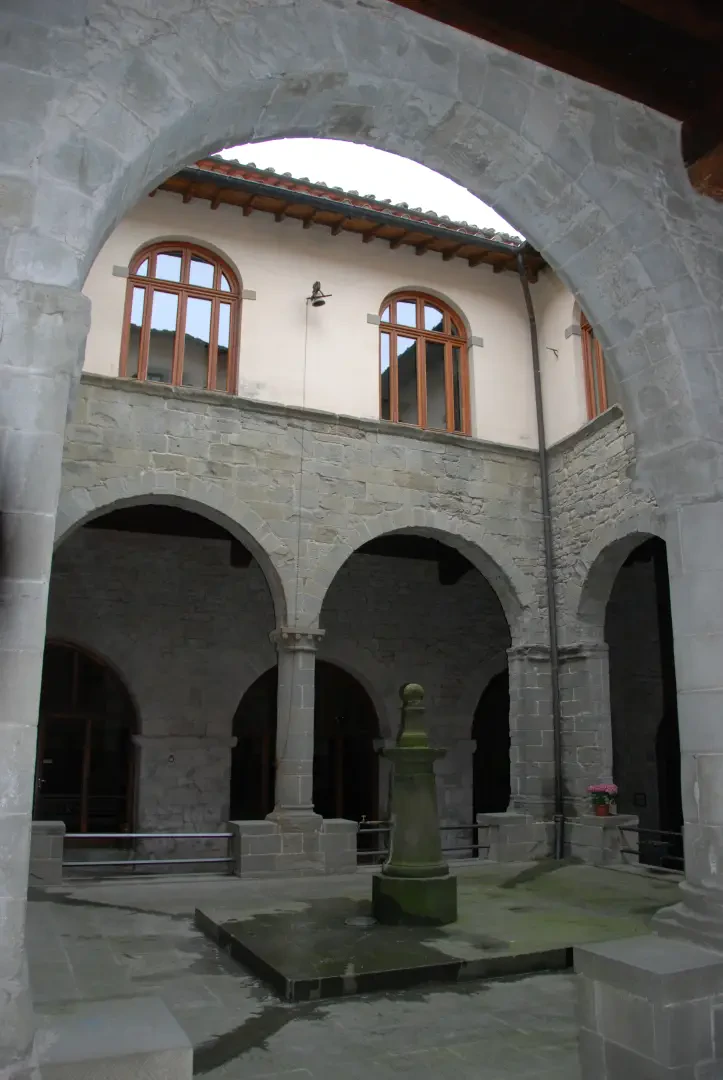
The Foresteria is the oldest part of the complex and preserves medieval rooms, such as the Chapel of the Holy Spirit and the Maldolo cloister, dating back to the 12th century. The entrance is decorated with the Camaldolese coat of arms, representing two doves drinking from the same chalice. In the Sala delle Accademie, also called 'del Landino' and featuring a wooden ceiling dating back to 1460, literary and scientific disputes were held between humanists, later collected and published by Cristoforo Landino. Among the participants were prominent personalities such as Marsilio Ficino, Leon Battista Alberti, Lorenzo the Magnificent and Mariotto Allegri, Prior General of the Order. The guest quarters are built around the 15th-century Chiostro dei Fanciulli, built by Ambrogio Traversari.
The monastery's pharmacy contains elegant carved walnut shelves dating back to 1543, as well as 16th-18th-century ceramic vases and glass containers. Above the pharmacy is the refectory, completed in 1609, decorated with a painting by Pomarancio depicting Jesus Restored by the Angels (1611).
The Hermitage
Climbing up to the Hermitage one encounters the 15th-century Chapel of the Madonna della Neve and the Chapel of San Romualdo. The Hermitage has kept almost intact the original structure designed by San Romualdo, with cells arranged in a fan shape around the Laura. At the end of the central avenue is the Pope's Chapel, built around 1220 and later incorporated into the library built in the 17th century.
The church of San Salvatore Trasfigurato, desired by St. Romualdo, has been renovated several times. The current building dates back to the late 17th century, while the façade, framed by two symmetrical bell towers, was completed in 1714. At the entrance is a narthex, separated from the nave by a carved and gilded wooden iconostasis (1659-1669). Among the works of art is a glazed terracotta from the workshop of Andrea della Robbia, depicting the Madonna with Child between Saints Romuald, Mary Magdalene, John the Baptist and Anthony Abbot (last decade of the 15th century).
On the right side of the narthex is a painting by Giovan Battista Naldini (c. 1575), depicting the Madonna with Child between Saints Benedict, Romualdo, Jerome and Lucy. Other notable works include an altarpiece from 1593, depicting the Christ Crucified between Saints Peter, Paul, Romuald and Francis of Assisi, and the ceiling fresco with episodes from the Life of the Madonna (1680). The chapter house, located next to the nave, has a 16th-century ceiling with faux marquetry, while the sacristy houses liturgical vestments and furnishings from the 17th-18th centuries, together with the pontifical chair carved by Luca Boncinelli and Antonio Montini (1669).
.