Liguria

Edited by:
Massimo Martini
Access
Liguria is accessible from northern Italy via a road network that follows the coastal and mountainous configuration of the region. The motorway links Turin to Savona; the descends from Milan to Genoa; the runs along the Riviera di Ponente to Ventimiglia at the French border; the connects Genoa to La Spezia along the Riviera di Levante; the climbs from La Spezia towards Parma through the Val di Vara; the links Genoa to Alessandria via the Giovi Pass. The provincial road network is characterised by numerous viaducts and tunnels crossing the Ligurian hills.
Rail services are operated by Trenitalia, with the two main hubs of Genoa Piazza Principe and Genoa Brignole, connected to the main Italian and European cities. The regional rail network serves almost the entire coastline, covering the four provinces and the main towns of both Rivieras. Cristoforo Colombo Airport in Genoa is the region's main international airport, located about 6 km from the city centre and served by AMT buses; Clemente Panero Airport in Villanova d'Albenga mainly serves the Riviera di Ponente with seasonal flights.
Introduction
Liguria occupies a narrow, elongated strip of territory in north-west Italy, wedged between the Alpine and Apennine chain to the north and the Ligurian Sea to the south. The region stretches along more than 300 kilometres of coastline from Ventimiglia at the French border to Ameglia at the Tuscan border, rarely reaching more than 30 kilometres in depth. The morphology is dominated by steep slopes descending directly to the sea, leaving limited space for coastal plains. It borders Piedmont and Emilia-Romagna to the north, France to the west, and Tuscany to the east. Genoa, the regional capital and metropolitan city, was for centuries one of the foremost maritime powers of the Mediterranean; its heritage as a Maritime Republic has left a lasting mark on regional identity, the architecture of the historic centre, and the trade routes that still define its port today.
Description
The physical structure of Liguria is determined by the Alpine-Apennine arc that separates it from Piedmont and Emilia-Romagna. The Ligurian Alps to the west are home to the region's highest peaks, with Monte Saccarello at 2,201 metres as the highest point; to the east the mountain system continues into the Ligurian Apennines, with progressively lower elevations but still steep, forested slopes. Deciduous woodland — downy oak (Quercus pubescens), hop hornbeam (Ostrya carpinifolia) and sweet chestnut (Castanea sativa) — covers most of the inland slopes, while Mediterranean maquis with holm oak (Quercus ilex), strawberry tree (Arbutus unedo) and myrtle (Myrtus communis) characterises the sea-facing slopes down to the coast. Watercourses are short and torrential.
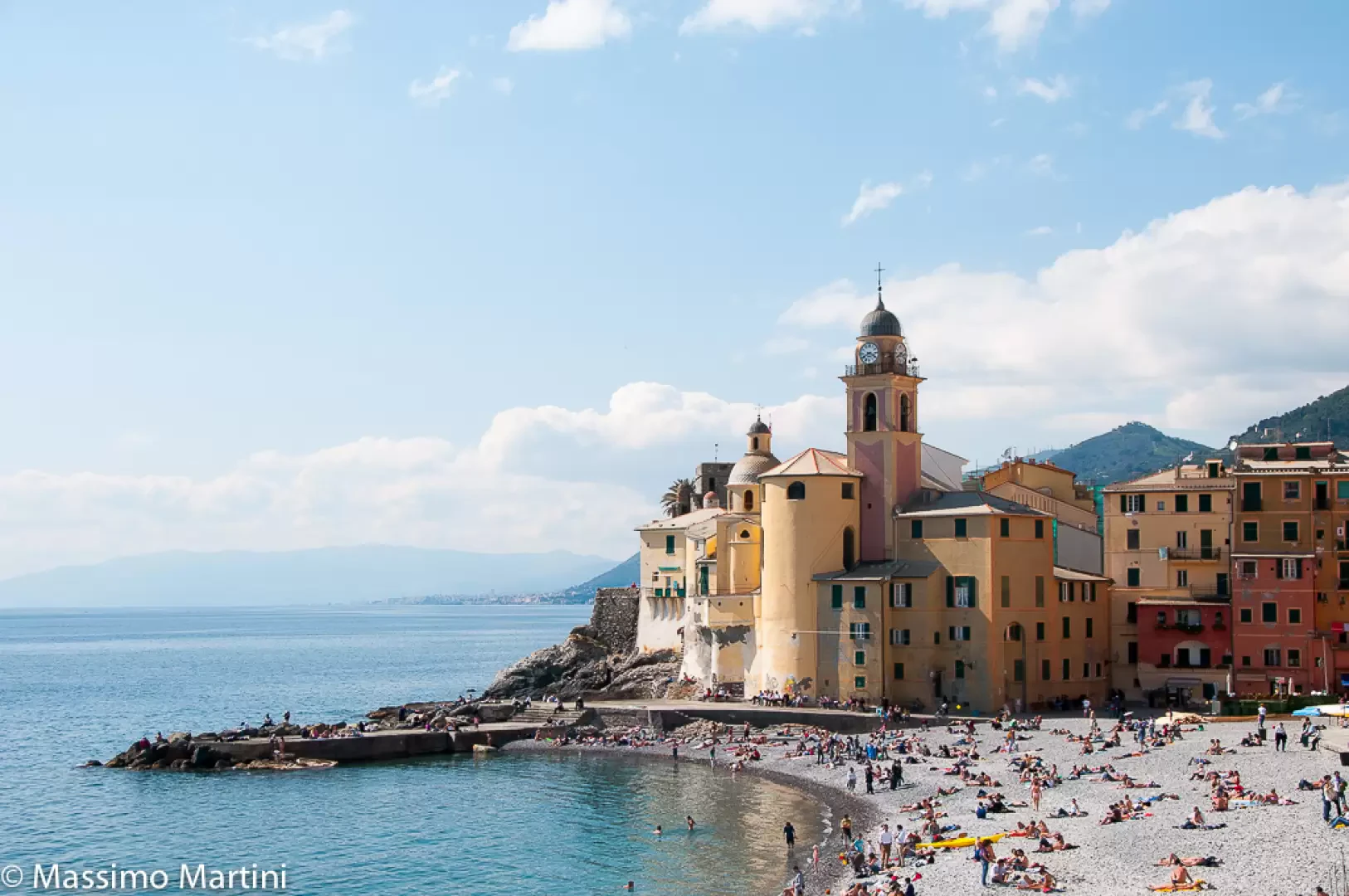
The coastline divides into two distinct sections. The Riviera di Ponente, from Ventimiglia to Genoa, has wider beaches and an especially mild climate that has favoured olive cultivation — with designated origin olive oil production — and floriculture, with the Sanremo flower district among the most active in Europe. The Riviera di Levante, from Genoa to the mouth of the Magra, is characterised by high, indented cliffs. The Cinque Terre — Monterosso, Vernazza, Corniglia, Manarola and Riomaggiore — form one of the most celebrated coastal landscapes of the Italian peninsula, with their vine terraces descending to the sea; the area is inscribed on the UNESCO World Heritage List. The Gulf of La Spezia, known as the Gulf of Poets for its association with nineteenth- and twentieth-century writers and artists, closes the Riviera di Levante to the east.
The Ligurian Sea is part of the Pelagos Sanctuary for Mediterranean Marine Mammals, an international marine protected area established in 1999 that safeguards populations of fin whale (Balaenoptera physalus), sperm whale (Physeter macrocephalus) and striped dolphin (Stenella coeruleoalba) in the north-western Mediterranean. The Cinque Terre National Park and the Portofino Regional Natural Park are the main terrestrial protected areas.
The history of Liguria is marked by Genoa's central role in medieval and Renaissance Mediterranean trade. The Republic of Genoa, active from the tenth to the eighteenth century, established a network of trading posts stretching from the Black Sea to North Africa. Christopher Columbus, born in Genoa around 1451, is the best-known historical figure associated with the region. Genoa's historic centre, with the narrow lanes of the caruggi and the Palazzi dei Rolli — a UNESCO World Heritage Site — preserves the architectural layers of this long merchant era.
The regional economy developed around the port of Genoa — among Europe's leading ports by cargo volume — and an industrial base linked to shipbuilding, steelmaking and precision mechanics. Typical products include Genoese basil (Ocimum basilicum) as the base of pesto, extra virgin olive oil from the Ligurian Riviera with protected designation of origin, Pigato wine from the Riviera di Ponente, and focaccia among the region's gastronomic traditions.
The Ligurian territory offers an extensive hiking network. The Alta Via dei Monti Liguri runs the length of the region for over 440 kilometres, from the Colle di Cadibona to the Passo di Magra, linking the Apennine passes and the main peaks in a multi-day trekking route. The Cinque Terre and Portofino Park trails are among the most visited in Liguria for day hiking. Trail running has found in Liguria a particularly favourable environment thanks to the combination of concentrated elevation gain, technical trails and coastal scenery: the Trail dei Monti Liguri circuit brings together several events along the Apennine arc, while races such as the Trail del Marchesato at Finale Ligure, the Val Maremola Trail in the Savona hinterland and the Genova Trail — linking the historic caruggi to the Alta Via dei Monti Liguri — draw Italian and international athletes. High-altitude areas of the Ligurian Alps allow for snowshoeing and ski touring. Mountain biking routes can be found throughout the inland hills and Apennine crests.
Information
General data
Regional capital: Genoa
Area: 5,421 km²
Minimum altitude: 0m (coast)
Highest point: 2,201m – Monte Saccarello
Population: 1,510,054 (as of 31.08.2024)
Inhabitants: Ligurians
Name in dialect: Ligûria
Provinces and metropolitan city: Metropolitan City of Genoa – Imperia – La Spezia – Savona
Municipalities: 234 – list - map
Neighbouring regions and territories: Emilia-Romagna – Piedmont – Tuscany (Italy); Provence-Alpes-Côte d'Azur (France)
Country: Italy
Official website: https://www.regione.liguria.it