Mont Saron

Edited by:
Massimo Martini
Access
Mont Saron is accessible only by hiking routes, without technical difficulties. The two main itineraries ascend the western and south-western slopes through a succession of pastures and mixed forest belts; the final section along the ridge, shared by both routes, has no clear waymarking and requires careful navigation. The trail from Chanté has sparse or absent signage in some sections, particularly at the point where it leaves the track. Access is possible from June to October; residual snow on the summit ridge may persist until early June. No dedicated winter routes are documented.
Summer ascent routes
» from Le Plan-de-Clavel, Chef-Lieu (1,272m) –
– E – 4h30' – (normal route)
» from Chanté (1,395m) –
– E – 4h00' –
Introduction
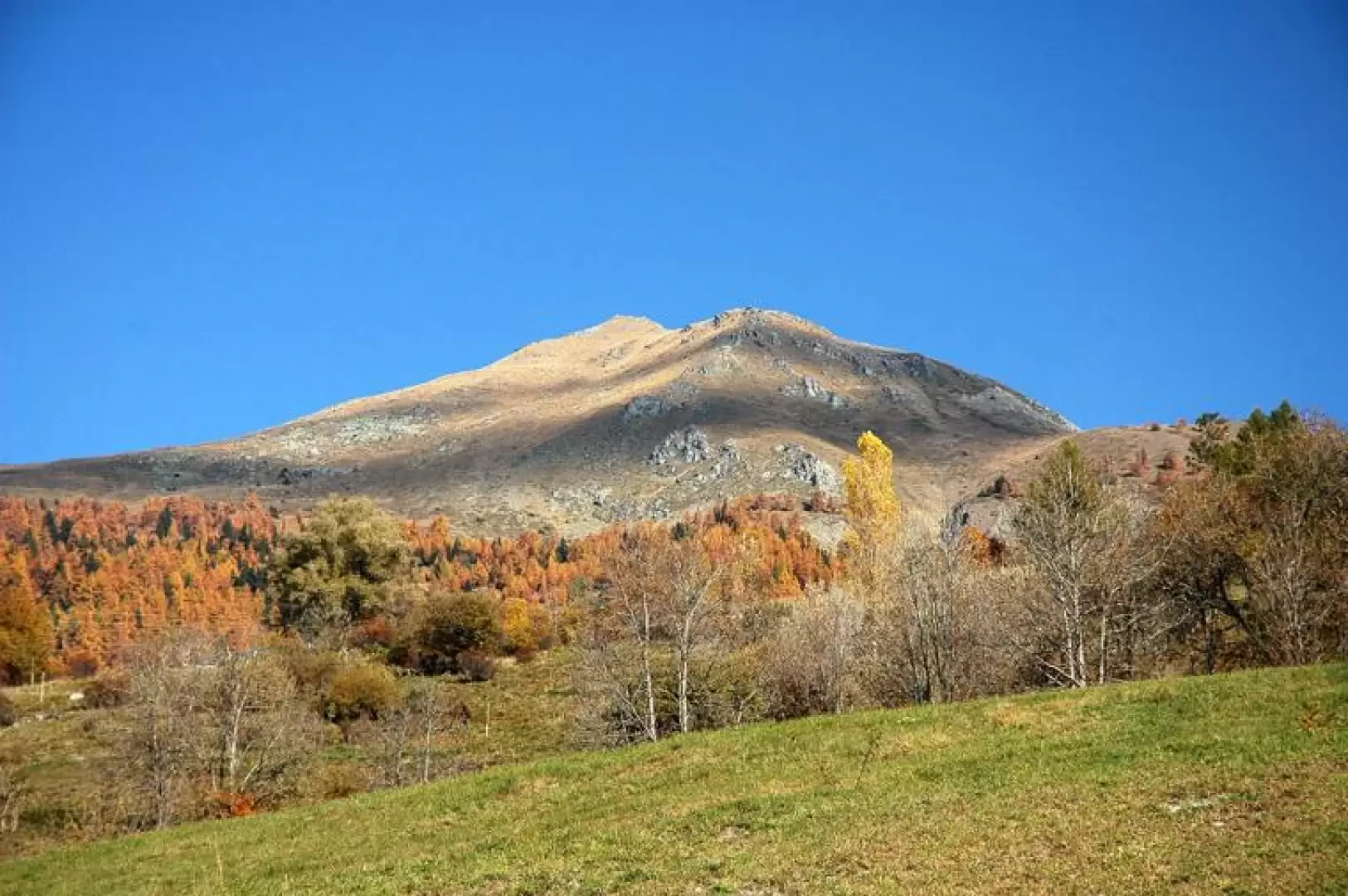
Mont Saron (2,681m) is a pyramid-shaped summit rising on the left orographic bank of the Great St Bernard valley, in the municipality of Allein. It belongs to the Grand Combin–Mont Vélan Chain, sub-section Aosta Valley and Valais Western Alps, section Pennine Alps according to the SOIUSA classification, and constitutes the most visible southern spur of the Mont Vélan massif. Its central position in the Aosta Valley makes it recognisable from Aosta and the plain below, where the pyramidal profile stands out clearly against the tree line on Allein's slopes. The summit is marked by a wooden cross; a second cross stands on the false summit along the ascent ridge. The first ascent is not documented. Mont Saron is deeply tied to the community of Allein: every year on 29 June, the feast of Saints Peter and Paul, a traditional procession sets off from the parish church and reaches the summit crossing the valley's alpine pastures, keeping alive the memory of an event which, according to local tradition, averted the threat of a landslide.
Description
Mont Saron sits on a watershed between the Great St Bernard valley to the west and the Valpelline to the east, though it does not form part of the main ridge: it is a southern spur of the Mont Vélan massif, separated from it by the succession of high alpine pastures that characterise Allein's slopes. The faces differ in morphology and vegetation: the western and south-western slopes, followed by the main paths, feature broad alpine meadows alternating with bands of larch (Larix decidua) and Norway spruce (Abies picea) up to around 2,000m; the eastern face descends along a more pronounced ridge, passable but poorly marked. From the summit, views extend across the Great St Bernard valley with the Hospice and the Pass, the By basin in the Valpelline, Mont Vélan, Grivola and Grand Nomenon; in clear conditions, Mont Blanc, Monte Rosa and the Grand Combin are visible.
Geologically, Mont Saron belongs to the Gran San Bernardo nappe system, part of the intermediate Pennidic Domain of the Alps. The bedrock consists primarily of metamorphic rocks — gneiss, micaschists and phyllites — formed by the transformation of ancient sediments and igneous rocks subjected to high pressures and temperatures during the subduction and continental collision processes that built the Alpine edifice. Reequilibrated in greenschist facies during the Alpine orogeny, these rocks give the slopes a rounded morphology and predominantly detritic erosion, clearly visible in the summit section where the stony terrain makes the path difficult to follow.
The alpinistic history of Mont Saron is not documented in available sources: the first ascent is unknown, as is the first winter ascent. The summit has never attracted significant alpinistic interest, being accessible by hiking without technical difficulty. Its historical use is linked to pastoral life and the alpine pastures on Allein's slopes — Fontane (1,892m), Parc (2,014m), Baravex — rather than to the nineteenth-century mountaineering exploration that characterises the major peaks of the group.
The place name Mont Saron is of Valdôtain patois origin, common in the Coumba Freida area. The most significant cultural element is the annual procession on 29 June, feast of Saints Peter and Paul: participants set off from the parish church in Le Plan-de-Clavel and reach the summit crossing the alpine pastures of the slope, according to oral tradition to avert the danger of a landslide. At the end of the procession, a communal meal is held at the foot of the summit; those who were unable to make the ascent receive from the walkers flowers gathered in the pastures — rhododendrons and violets. The territory of Allein is documented in Roman times as a transit route towards Octodurus (modern Martigny): the Roman presence is confirmed by the discovery in 1856 of silver Republican-era coins in the municipal territory, preserved in part at the Académie Saint-Anselme museum in Aosta.
Current use is almost exclusively local and recreational. The summit is also reached by those walking the Tour des Combins, the major cross-border trek that passes at the foot of the slope via the Dortoir Baravex, an alternative stopping point to the Col de Champillon.
Shelters
» Dortoir Baravex (1,910m)
Information
Altitude: 2,681m
Mountain group: Grand Combin–Mont Vélan Chain, Aosta Valley and Valais Western Alps
Alpine range: Pennine Alps
Type: pyramid
Protected area: none
First ascent: not documented
Summit register: absent
Municipality: Allein (AO)
Valley: Great St Bernard Valley / Coumba Freida
Hiking difficulty: E
Average elevation gain: 1,249–1,434mD+
Recommended period: June–October
Prevailing aspect: W, SW
Glaciers: no
Fixed equipment: no
Collections
peaks of the Aosta Valley – list – map
peaks of the Grand Combin–Mont Vélan group – list – map
peaks of Allein – list – map
peaks above 2,000m – list – map