Sasso Simone and Simoncello Natural Park

Edited by:
Massimo Martini
Access
Introduction
The Sasso Simone and Simoncello Natural Park was established in 1994 and covers a total area of 4,991 hectares in the heart of the ancient Montefeltro region, straddling the Marche and Emilia Romagna regions.
Description
The LANDSCAPE - HISTORY AND CULTURE
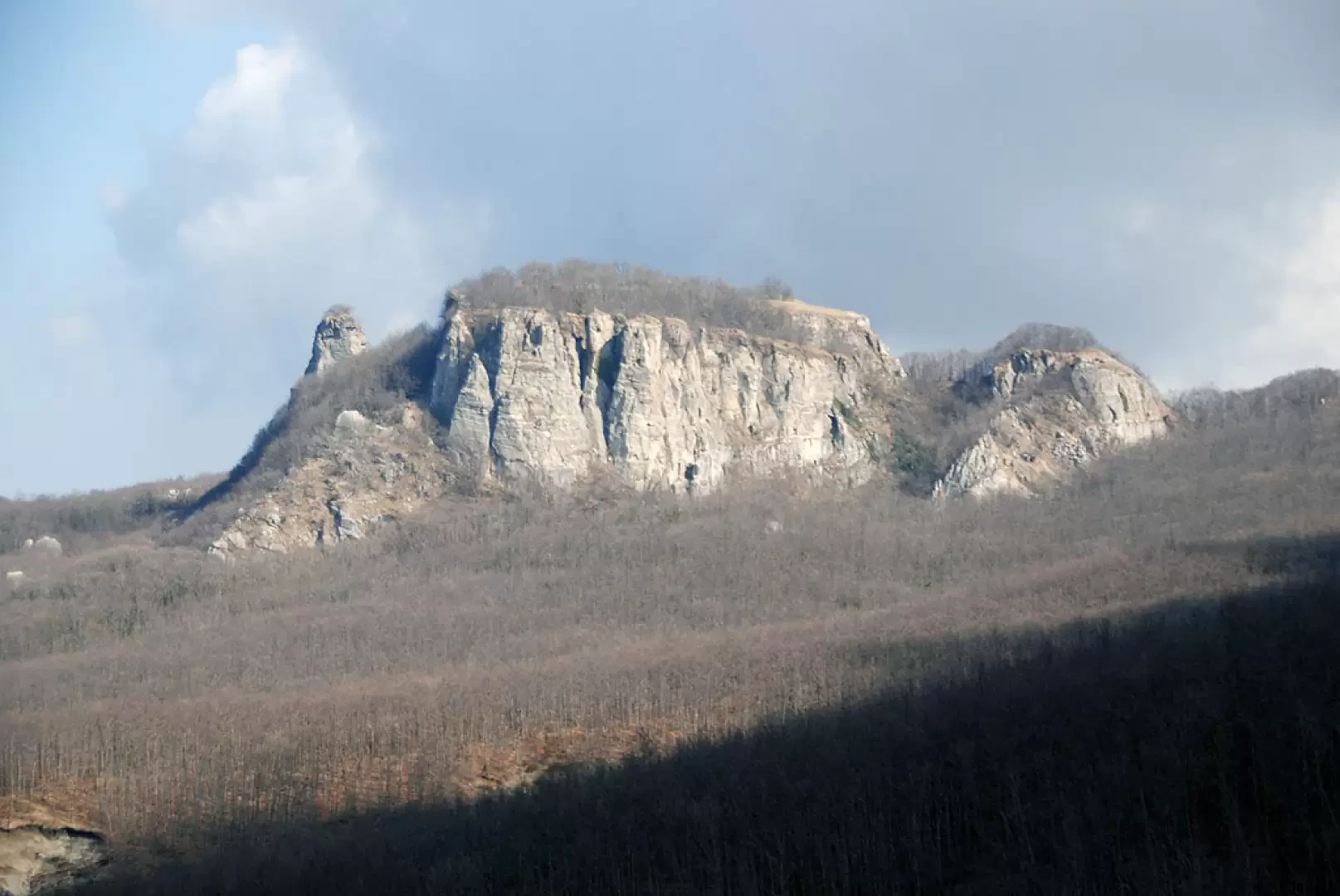
The hilly-mountainous landscape is dominated by the Sasso Simone (1204 m) and Simoncello (1221 m) mountains, with altitudes ranging from 670 m to 1415 m on Monte Carpegna, the highest peak in the park and the watershed between the Foglia and Marecchia Valleys. The Sasso Simone and Simoncello Park is the fruit of a delicate and discreet human history, which has allowed nature to continue its silent work undisturbed for millennia. The hilly landscape is covered by thick vegetation, interrupted by rugged cliffs and rocky spurs on which 'impregnable' fortresses were built to defend against the enemy. It is an area, therefore, rich in castles, fortresses, but also churches, convents and parish churches. The park takes its name from two enormous boulders, Simone and Simoncello, which were inhabited by man since the Bronze Age. Some legends tell of Roman priests, the 'semoni', who worshipped their gods there, or of a hermit, Simone, who made his home there. It was probably a refuge for people during the Longobard and Byzantine raids, but the harshness of the climate did not make it easy for man to settle on the rock. It was essentially the strategic vocation of the site that motivated the main 'urbanisers' of Sasso Simone; the Benedictines in the 12th century, the Malatesta in the 15th, and the Medici at the end of the 16th century. The former were responsible for the construction of an abbey dedicated to Sant'Angelo, probably on the site of a Lombard-era chapel. The arrival of particularly harsh winters and the opening of new and more convenient pilgrimage routes contributed to the decay of this site, which saw a major and almost definitive collapse with the plague of 1348. When the lords of these lands realised its strategic-military importance, the Sasso was fortified with towers and walls and, in the second half of the 16th century, the Medici built a fortress-city there to assert their power in an area that was difficult to govern. Still visible today are the ruins of that 'ideal city', abandoned in 1673, of which the sun - as it is today for the park - was the symbol.
From a geological point of view, the entire area of the Sasso Simone and Simoncello Natural Park consists of a vast blanket of heterogeneous chaotic soils called the 'Marecchia Valley Melt'.
The area considered to be the 'colata' is mainly made up of highly deformable plastic clayey and clayey-marly soils and incorporates mostly more rigid and compact limestone blocks of various sizes. The erosive processes caused by water, wind and snow, acting selectively on the blanket, erode and remove the softer clayey-marly materials much more quickly, causing the blocks of harder rocks to emerge in relief: this is how "I Sassi", the typical morphologies of Montefeltro, originated.
FLORA
The flora of the park is very varied and diversified according to altitude. The vegetation at altitudes below 800 metres is characterised by forests with a high mixture of tree species. Downy oak, Turkey oak, hop hornbeam, manna ash, field maple and Neapolitan maple are the most common trees, and among the shrubs, dogwood, dogwood and hazelnut. The turkey oak dominates, together with the hornbeam, the vast Mediterranean-mountain forest that stretches from the Cantoniera Pass over 800 hectares to Sassi Simone and Simoncello and Valpiano; along with them are holly, various types of maple, the greater ash and beech; in the undergrowth grow numerous typical forest grass species such as the common baccaro and the martagon lily, while the mountain cornflower thrives on the forest margins. On the sunny slopes, used mainly for grazing, the plant landscape is dotted with shrubs such as the common juniper, dog rose, hawthorn, blackthorn and bramble. In the woods at altitudes above 1000m, where the climate is cooler, beech predominates, accompanied by sycamore maple and sometimes yew, curly maple, alpine laburnum and holly, while ferns sprout from the dense carpet of leaves.
On the eastern slope of Monte Carpegna, reforestation was also carried out in the first half of the 20th century, mainly using black pine. The pastures of Monte Carpegna, situated at altitudes of around 1200 - 1400m, derive from ancient cuts of beech and probably also fir woods; in early spring, the green of these meadows is tinged with the colour of crocus, followed by multicoloured orchids and, lastly, colchicum, at the end of summer.
In the woods and meadows, during the spring and autumn seasons, mushrooms of various species sprout, true delicacies that make these places the destination of passionate researchers and lovers of the flavours of the undergrowth.
The Simoncello, the woods of the Cantoniera and the Costa dei Salti are Protected Floristic Areas, while Monte Carpegna is also included in the state-owned forest of the same name.
The FAUNA
The Park is home to numerous species of wild animals: including the wolf, badger, weasel, stone marten and polecat. The smallest and most widespread of the ungulates is the roe deer; in the evening at dusk or in the early morning it is easy to see it coming out of the thicket to feed in the clearings and uncultivated land.
The wild boar, as in almost all the Apennines, is now present following some introductions of specimens from central Europe, carried out decades ago, for hunting purposes. Amphibians include the crested and spotted newt, tree frog, common toad and geotriton. Among the reptiles, in addition to the common viper, there are the grass snake, the grass snake, the wall and field lizard, the luscengola and the orbettino.
There are various species of birds of prey that can be observed, in different periods and environments: among these are the sparrow hawk and the goshawk, characterised by a relatively long tail that gives them a safer ability to fly in the woods of the area. Easier to spot because they are more toothed and common, are the kestrel and the buzzard; the former can be observed as it hovers in the air in the attitude of the 'holy spirit' in hunting activity, over meadows and pastures; the latter as it draws wide circles in the sky emitting its characteristic cry. If one is lucky and attentive, it is also possible to spot the golden eagle, peregrine falcon and lanner, which, although not nesting in the area, frequent its open areas in hunting activity. With the arrival of fine weather, numerous migratory birds can be seen, which, after spending the winter in Africa, return to occupy the territories of the Park and surrounding areas. It is then possible to encounter the short-toed eagle owl, the hobby, the honey buzzard and the hen harrier. Other birds of prey are only passing through during migration, such as the marsh harrier; others, such as the hen harrier, can be observed in winter on meadows and pastures. Among the nocturnal birds of prey are the barn owl, the little owl, the long-eared owl and the tawny owl.
Tourist offer
The Park, among its many activities, has undertaken operational strategies aimed not only at protecting and enhancing the area as a whole, but also at strengthening the structures for territorial enjoyment. Thus, rest areas have been equipped from which to set off on pleasant walks or more demanding excursions. Guided tours, orienteering and Nordic walking activities are also possible. Itineraries have also been marked out that can be followed by mountain bike or on horseback. Visits accompanied by Park Guides take place throughout the year; for schools, there are also numerous environmental education proposals promoted by the Park through its CEA.
The Pian dei Prati Fauna Park is ideal for visiting school groups and families: in an area of 5.5 hectares, it is possible to take a route to get to know domestic farm animals such as goats, sheep, mules, as well as the close observation of some particular wild animals such as birds of prey, roe deer, wild boars, frogs, toads and newts. The Fauna Park can also be used for lessons, guided visits, camps, etc., even by the differently abled, thanks to a specially designed trail.
A Visitor Centre is annexed to the park headquarters in Carpegna, as well as in Ponte Cappuccini in the municipality of Pietrarubbia, while in the ancient town of Pennabilli, seat of the Episcopal Diocese, the Park has set up an interesting nature museum in an old renovated building. In Frontino, at the Montefeltro Multipurpose Centre, as well as in Calvillano di Pietrarubbia, there is a guesthouse. A CEA also operates in the latter locality, while in San Sisto di Piandimeleto there is the Centro Informatico Servizi Ambientali del Montefeltro and the Mushroom Museum.
A visit to the Park is also pleasantly enlivened by the exceptional typical products and local gastronomy: here, in fact, it is possible to savour numerous delicacies based on mushrooms and truffles (both black and white), Carpegna ham, which boasts PDO recognition, various types of pecorino cheese, both fresh and mature, and numerous culinary specialities that combine the traditions of the Marche, Romagna and Tuscany.
Information
Year of foundation: Established by Regional Law no. 15 of 28/04/1994
Area: 47.9104 square kilometres
Main elevation:Mount Carpegna (1415m)
Municipalities concerned: Carpegna, Frontino, Montecopiolo, Pennabili, Piandimeleto, Pietrarubbia
Institutional site: www.parcosimone.en
Contact: info@parcosimone.it centrovisite@libero.it cv.museonat@libero.it