Pollino Park

Edited by:
Massimo Martini
Access
The Pollino National Park can be reached via the Mediterranean motorway (formerly the A3 Salerno-Reggio Calabria), which runs along the Tyrrhenian side of the park with several relevant junctions: the Lauria exit for the north-western Lucania sector; Mormanno for the northern Calabrian Tyrrhenian side; Frascineto-San Basile for the southern sector; Spezzano Albanese-Lungro for the Sibari Plain and the municipalities in the southern valleys. On the Ionian side, access is via the coastal roads and the state road Jonica, with ascent through the Raganello, Coscile, Esaro, Sarmento and Sinni valleys. The Park Authority headquarters are in Rotonda (PZ), in the Santa Maria della Consolazione monumental complex. The main access gates are Lauria and Rotonda for Basilicata; Castrovillari, Mormanno and Morano Calabro for Calabria. Numerous visitor and information centres are distributed throughout the park's 56 municipalities, including the Artemis Museum in San Sosti and the Eco-museum of Pollino "S. Berardone". The main railway connection is the Tyrrhenian line (Naples-Reggio Calabria) with stations at Lauria-Trecchina, Mormanno and Scalea on the Tyrrhenian side; the Ionian line (Taranto-Reggio Calabria) serves the eastern side. Regional buses connect the inland municipalities. The reference airport for the Calabrian side is Lamezia Terme; for the Lucanian side, Naples or Bari.
.Introduction
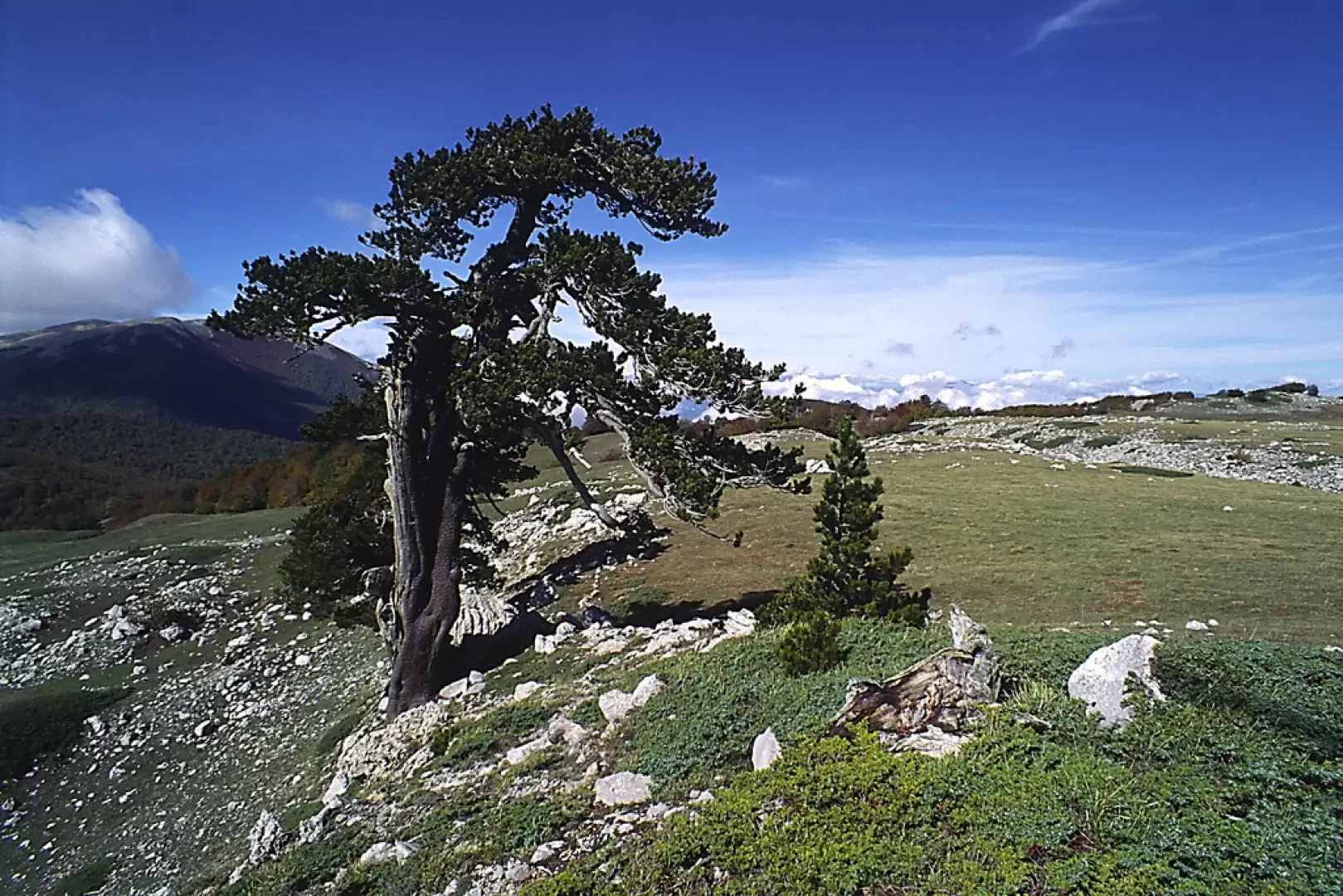
The Pollino National Park is the largest of the newly established national parks in Italy, covering 192,565 hectares straddling Calabria and Basilicata, in the provinces of Cosenza, Potenza and Matera, comprising 56 municipalities, 32 in Calabria and 24 in Basilicata. Established by the Presidential Decree of 15 November 1993, published in Official Gazette No. 9 of 13 January 1994, it is home to the highest peaks in the southern Apennines - the Serra Dolcedorme (2,267 m) - and stretches from the Tyrrhenian Sea to the Ionian Sea, from the great limestone massifs of Pollino and Orsomarso to Mount Alpi. The symbol of the park is the loricate pine (Pinus leucodermis), a glacial relict that only grows in this area in Italy: among these specimens is "Italus" a 1,236-year-old loricate pine that has been scientifically dated as the oldest tree in Europe. Since 2015, the park has been a UNESCO World Geopark; the ancient beech forests of Cozzo Ferriero (2017) and Pollinello (2021) are UNESCO World Heritage Sites in the transnational site "Ancient Primordial Beech Forests of the Carpathians and other European Regions".
Description
The park area comprises three distinct mountain systems: the Pollino Massif, with its main peaks - Serra Dolcedorme (2,267m, the highest in the southern Apennines), Monte Pollino (2,248m), Serra di Crispo (2.053m) and Serra delle Ciavole with the most impressive specimens of loricate pine - the Monti dell'Orsomarso in the southern Calabrian sector, with Cozzo del Pellegrino as the main peak, and Monte Alpi in the northern Lucanian sector. From the Pollino massif it is possible, on a clear day, to see three seas: the Ionian, the Tyrrhenian and the Adriatic - the only relief in the Apennines with this characteristic. The geology is predominantly Mesozoic calcareous-dolomitic, with outcrops of crystalline metamorphic rocks in the Calabrian Arc; the structure of the Pollino is one of the keys to understanding the relationship between the Peloritano-Calabrian Arc and the Southern Apennines. Karst phenomena are widespread throughout the upper area: dolines, karst plateaus - such as the Piani del Pollino and Novacco - swallow holes, caves and seasonal snowfields, including the one on Mount Pollino at 2,225 m, still visible at the end of August. The river system is among the richest in southern Italy: the Lao, Mercure, Peschiera, Argentino, Raganello, Coscile, Frido and Sarmento rivers furrow the territory, carving deep and spectacular gorges. The Raganello Gorge, with rock walls up to 700m high, is one of the most extraordinary environments in the park; reached by climbing 615 steps from the summit, it is a popular venue for hiking, canyoning and rafting. The Lao River, one of the largest on the Tyrrhenian slope, is one of the park's main areas for rafting and river activities.
The vegetation is divided into altitudinal belts from the coastal Mediterranean scrub to the high-altitude plains. Up to 1,000m, forests of downy oak (Quercus pubescens), turkey oak (Quercus cerris) and holm oak (Quercus ilex) dominate; between 1,000 and 1.800m are beech forests (Fagus sylvatica) pure and mixed with chestnut, turkey oak and maple trees - including the Lobel maple (Acer lobelii), a species of Community interest that is rare in Italy. Above the beech forests and on the steepest slopes, the black pine (Pinus nigra) dominates, giving way, above 1,800m and on the most inaccessible ridges, to the loricate pine (Pinus leucodermis). The silver fir-beech association - particularly developed in the Magnano Forest and the Acquaformosa Forest - is among the most valuable forest formations in southern Italy. The flora has about 1,700 vascular species, with endemisms and rarities of Mediterranean value: the Pollino bellflower (Campanula pollinensis), the wild peony (Paeonia mascula), wild orchids, gentians and narcissus. Forest peonies (Paeonia officinalis) grow in the more sheltered and damp stations. The loricate pine is the true protagonist of the high-altitude landscape: the most iconic specimen, "Italus", grows in the Serra delle Ciavole at an altitude of 1,900m, has a dendrochronologically determined age of 1,236 years and a trunk circumference of over 3m. The ancient beech forests of Cozzo Ferriero (764 hectares) and Pollinello - included in the UNESCO World Heritage List in 2017 and 2021 respectively - are home to beech trees over 400 years old and a biodiversity of fungi, lichens and invertebrates of exceptional scientific value.
The fauna is among the richest and most diverse in southern Italy. The Apennine wolf (Canis lupus italicus) is present with 20 to 30 individuals; the Italic roe deer (Capreolus capreolus italicus) has in this area one of the most important autochthonous nuclei in southern Italy, preserved thanks to the conformation of the land. The otter (Lutra lutra), the rarest mammal in the park, frequents the most intact watercourses. The golden eagle (Aquila chrysaetos) nests in the area, along with the lanner (Falco biarmicus), red kite (Milvus milvus), Egyptian vulture (Neophron percnopterus) and peregrine falcon (Falco peregrinus). The griffon vulture (Gyps fulvus) has been the subject of a reintroduction project in the park. The black woodpecker (Dryocopus martius) and the green woodpecker occupy the mature beech forests. Invertebrates include the Rosalia alpina (Rosalia alpina), the blue beetle of the ancient beech forests, and the Buprestis splendens, one of the rarest beetles in Europe.
The history of the Pollino is a thousand-year stratification of cultures and populations. Palaeontological findings in the Romito Cave - in the Mercure Valley - document the presence of large Pleistocene mammals such as the primeval ox (Bos primigenius) and the ancient elephant (Elephas antiquus). Evidence of Greek colonisation (Sybaris, on the Ionian coast) and Lucanian civilisation overlaps with Byzantine, Lombard and Norman civilisation. The most original cultural trait of the park is the presence of numerous Arbëreshë - Italo-Albanian - communities that settled between the 15th and 18th centuries in the Calabrian-Lucanian territory after the death of George Castriota Skanderbeg (1468) to escape the Ottoman advance: these villages, spread across the municipalities of Civita, Acquaformosa, Lungro, San Basile, Plataci, Frascineto and others, still conserve the Arbëreshë language, the Greek-Byzantine rite, traditional costumes and their own cuisine. Civita - "Nido d'Aquila" in arbëreshë - is the most emblematic village, suspended over the Raganello canyon; Lungro is the seat of the Eparchy of Lungro, a Catholic diocese of the Greek-Byzantine rite. Castelsaraceno is home to the world's longest Tibetan bridge, connecting the Pollino Park with the Val d'Agri-Lagonegrese Lucano Apennine Park.
Information
General data
Typology: National Park; UNESCO World Geopark (from 2015); UNESCO World Heritage Site - Cozzo Ferriero (from 2017) and Pollinello (from 2021), included in the transnational site "Ancient Primordial Beechwoods of the Carpathians and other European Regions"
Year of establishment: 1988 (Law no. 67 of 11 March 1988); park authority: Presidential Decree of 15 November 1993 (Official Gazette no. 9 of 13 January 1994); re-registration: Presidential Decree of 2 December 1997 (Official Gazette no. 9 of 13 January 1994); re-establishment: Presidential Decree of 2 December 1997 (Official Gazette no. 9 of 13 January 1994). 67); Park Authority: Presidential Decree 15 November 1993 (G.U. no. 9 of 13 January 1994); Re-establishment: Presidential Decree 2 December 1997; UNESCO Geopark: 2015; UNESCO ancient beech forests: Cozzo Ferriero 2017, Pollinello 2021
Management Body: Pollino National Park Authority
Reference Agency: Ministry of the Environment and Energy Security
Area: 1.925.65 km²
Minimum elevation: ~100m
Maximum elevation: 2,267m
Maximum elevation: 2,267m - Serra Dolcedorme (Viggianello PZ / San Lorenzo Bellizzi CS)
Region(s): Basilicata - Calabria
Provinces: Cosenza - Matera - Potenza
Municipalities involved - Calabria, Province of Cosenza (CS): Acquaformosa - Aieta - Alessandria del Carretto - Belvedere Marittimo - Buonvicino - Castrovillari - Cerchiara di Calabria - Civita - Francavilla Marittima - Frascineto - Grisolia - Laino Borgo - Laino Castello - Lungro - Maierà - Morano Calabro - Mormanno - Mottafollone - Orsomarso - Papasidero - Plataci - Praia a Mare - San Basile - San Donato di Ninea - San Lorenzo Bellizzi - San Sosti - Sangineto - Sant'Agata di Esaro - Santa Domenica Talao - Saracena - Tortora - Verbicaro
Communes concerned - Basilicata, Province of Matera (MT) San Giorgio Lucano - Valsinni
Municipalities concerned - Basilicata, Province of Potenza (PZ): Calvera - Carbone - Castelluccio Inferiore - Castelluccio Superiore - Castelsaraceno - Castronuovo di Sant'Andrea - Cersosimo - Chiaromonte - Episcopia - Fardella - Francavilla in Sinni - Latronico - Lauria - Noepoli - Rotonda - San Costantino Albanese - San Paolo Albanese - San Severino Lucano - Senise - Teana - Terranova di Pollino - Viggianello
Official website: https://www.parconazionalepollino.it