Majella Park

Edited by:
Massimo Martini
Access
The Majella National Park can be reached via the Rome-Pescara motorway (Autostrada dei Parchi), which runs along the northern side of the massif: from Pescara take the Adriatica to Pescara Nord and then the ; from Rome take the to the junction with the ; from Naples take the to the Caianello exit and continue towards Venafro, Roccaraso and Sulmona. The main exits for access to the park on the A25]v are Sulmona (for the western side), Caramanico (for the north-eastern side) and Bussi-Popoli (for the northern side). The Park Authority headquarters is located in Guardiagrele (CH), Via Occidentale 6. There are four natural gateways to the park: Sulmona to the west (access to the Cinque Miglia plateau and Morrone), Pescocostanzo to the south, Guardiagrele to the east and Lettomanoppello to the north. Visitor centres are distributed on all sides: in Lama dei Peligni (Archaeological Nature Museum with chamois dioramas), Caramanico Terme (nature and archaeological sections), Palena (Museum of the Marsican Bear), as well as facilities in Campo di Giove, Fara San Martino, Serramonacesca, Roccarmorice and Pacentro. The railway connection uses the Rome-Sulmona-Pescara line of Trenitalia (TI), with stations at Sulmona, Pratola Peligna, Corfinio, Popoli, Bussi, Tocco-Castiglione and Caramanico; the Sulmona-Carpinone line serves the municipalities on the south-west side (Cansano, Campo di Giove, Palena, Rivisondoli-Pescocostanzo). Local transport is operated by TUA Abruzzo buses. The nearest airport is Pescara (Aeroporto internazionale d'Abruzzo).
.Introduction
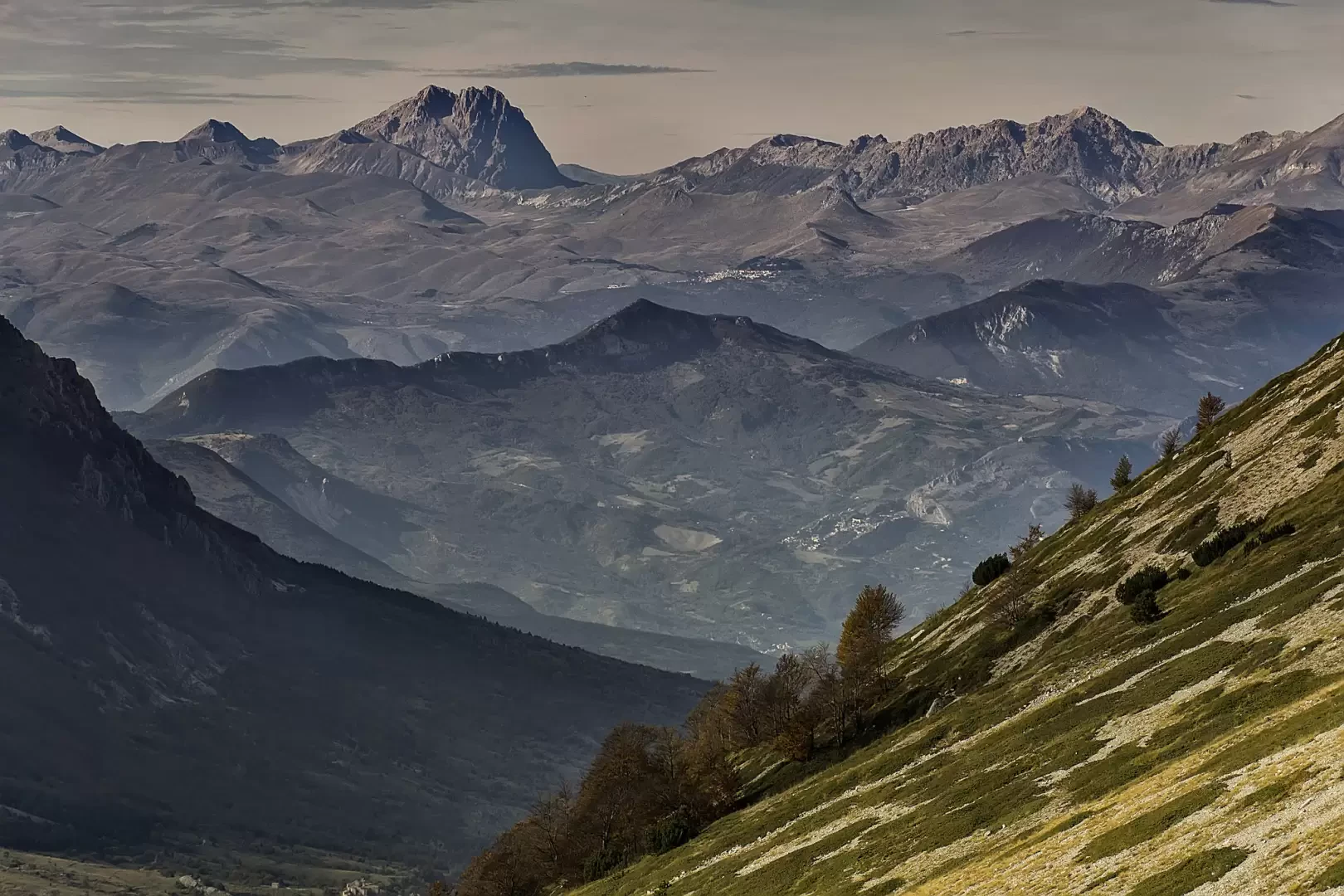
The Majella National Park extends into the heart of the central Abruzzo Apennines, in the provinces of L'Aquila, Chieti and Pescara, covering an area of 740.95 km² spread over thirty-nine municipalities. Established under Framework Law No. 394 of 6 December 1991, with the park authority established by Presidential Decree of 5 June 1995, it is one of the three national parks of Abruzzo. It clusters compactly around the large limestone-dolomite massif of Majella, the adjacent Morrone to the west, Monti Pizzi and Porrara to the east, and the Altipiani Maggiori d'Abruzzo to the southwest. Monte Amaro (2,793m) is the second highest peak in the Italian Apennines. Since 22 April 2021, the park has been a UNESCO World Geopark - "Majella Geopark" - due to the international significance of its geodiversity: the limestones of the massif record 140 million years of sedimentation in a shallow tropical sea, in a setting resembling the present-day Bahamas archipelago. The Majella is known as the "mother mountain" of Abruzzo and holds a concentration of hermitages and rocky places of worship unique in the Apennines, linked to Celestine hermitism in the 13th century
.Description
The Majella massif is geologically one of the most singular in the Apennines: its limestones - deposited on the bottom of a shallow tropical sea between 140 and 7 million years ago - constitute one of the few carbonate platforms in the world that can be observed in outcrop in its stratigraphic completeness, hence the scientific importance that justified its recognition as a UNESCO Geopark. The orogenesis is recent (Pliocene, around 5 million years ago). The massif is characterised by its high mountainousness: 55% of the territory lies above 2,000m, with sixty peaks, thirty of which exceed 2,000m. The main peaks of the Majella group are Monte Amaro (2,793m), Cima delle Murelle (2,598m) and Pizzone (2,458m); Morrone peaks at 2,061m. The architecture of the massif is characterised by vast summit plateaus gently shaped by Quaternary glaciers - among which the Femmina Morta plateau stands out - and by asymmetrical slopes: the eastern side is cut by a series of canyons that are among the longest in Italy, such as the Val Mandrelle-Santo Spirito and the Val Taranta, while the western side is more open towards the basins of Sulmona and Caramanico. The Orta River separates the Majella from the Morrone, forming a deep canyon in the section between Bolognano and San Valentino.
The flora of the park has more than 2,100 species and subspecies, corresponding to about 30% of the Italian flora and 17% of the European flora - a third of the entire Italian flora for a single protected area. One hundred and forty-two are endemics; of these, five are exclusive to the park: the limestone soldanella, the Majella cornflower (Centaurea majellensis), the Fiori butterwort (Pinguicula fiorii), the Majella radicchio and the multi-toothed buttercup. Many entities of the flora bear the specific epithet majellensis, a sign that the Majella constitutes the locus classicus - the site of the type specimen - of dozens of species described here for the first time by science. Beech forests (Fagus sylvatica) cover the slopes between 1,000 and 1,800 metres; on the ridges and above 1,800 metres, the dwarf pine (Pinus mugo), a species typical of northern European environments, spreads, with the southernmost station in the Apennines; at lower altitudes, mixed oak forests of downy oak, turkey oak, black hornbeam and manna ash prevail. In the Bosco di Sant'Antonio in Pescocostanzo there are specimens of beech trees over 600 years old, including the famous "candelabrum beech" over 600 years old.
The fauna is among the richest in the Apennines. The park is home to the largest nucleus of Marsican brown bears (Ursus arctos marsicanus) found outside the Abruzzo, Lazio and Molise National Park: monitoring in 2019 confirmed at least 15 specimens between stable and erratic, with reproductive females. The Apennine chamois (Rupicapra pyrenaica ornata) - reintroduced in 1991 with specimens from the Abruzzo National Park - now numbers more than 1,500 animals in 2021, the most important population of the species. The Apennine wolf (Canis lupus italicus) and the otter (Lutra lutra) are present in the most intact areas. The avifauna counts more than 200 species, with the white-backed woodpecker (Dendrocopos leucotos) - one of the few Italian populations - and the piping plover (Charadrius morinellus), a typical species of the Scandinavian tundra that in Mediterranean Europe nests exclusively in the high altitude stony ground of the Majella: its presence here is of international importance. The lanner (Biarmicus falcon), golden eagle (Aquila chrysaetos) and eagle owl (Bubo bubo) complete the picture of large birds of prey. Among the reptiles, the Orsini viper (Vipera ursinii), an extremely rare Apennine endemic species that lives in the high-altitude grasslands, is worth mentioning.
The Majella has been frequented by man since the beginning of the Palaeolithic period, around 800,000 years ago, as the Homo erectus deposits testify. The cave paintings of the Grotta dei Piccioni in the Orta River Valley document the presence of Palaeolithic and Neolithic hunters. Hermitism is the most characteristic cultural phenomenon of the mountains: since the early Middle Ages, monks and anchorites have sought refuge and inspiration in the Majella, digging hermitages in the rock faces and caves. Fra' Pietro da Morrone - who lived as a hermit on Mount Morrone and founded the Celestine Order in 1254, later to become Pope Celestine V in 1294 and abdicated a few months later - is the figure who more than any other has spiritually connoted the Majella landscape. The Celestine hermitages are among the most visited historical sites in the park: Sant'Onofrio al Morrone, San Pietro al Morrone, Santo Spirito a Majella, San Bartolomeo di Legio, San Giovanni all'Orfento and the Abbey of San Liberatore a Maiella. Along the Grotta del Cavallone in Taranta Peligna - accessible by cable car - Gabriele D'Annunzio set a scene from the tragedy "La figlia di Iorio" (1904). The paths in the park include the Cammino di Celestino and the Cammino degli Eremi Rupestri; the five ski resorts (Passolanciano-Maielletta, Passo San Leonardo, Pescocostanzo, Pizzoferrato-Gamberale, Campo di Giove) make the park popular all year round.
.Information
General data
Typology: National Park; UNESCO World Geopark (from 22 April 2021 - "Majella Geopark")
Year of establishment: 1991 (Law 6 December 1991, no. 394); park authority: Presidential Decree 5 June 1995 (G.U. no. 181 of 4 August 1995); Ministerial Decree 4 December 1992 (provisional perimeter); UNESCO World Geopark: 22 April 2021
Managing body: Majella National Park Authority
Reference body: Ministero dell'Ambiente e della Sicurezza Energetica
Area: 740.95 km²
Minimum altitude: 130m
Maximum altitude: 2.793m
Maximum elevation: 2,793m - Monte Amaro (Palena CH / Lama dei Peligni CH)
Region(s): Abruzzo
Provinces: Chieti - L'Aquila - Pescara
Municipalities involved - Province of Chieti (CH): Casoli - Civitella Messer Raimondo - Fara San Martino - Gessopalena - Guardiagrele - Lama dei Peligni - Lettopalena - Montenerodomo - Palena - Pennapiedimonte - Pizzoferrato - Pretoro - Rapino - Taranta Peligna
Municipalities affected - Province of L'Aquila (AQ): Campo di Giove - Cansano - Pacentro - Pescocostanzo - Pratola Peligna - Rivisondoli - Roccaraso - Sant'Eufemia a Maiella - Sulmona - Tocco da Casauria [to be verified: list 39 municipalities complete]
Municipalities affected - Province of Pescara (PE): Abbateggio - Bolognano - Caramanico Terme - Lettomanoppello - Manoppello - Roccamorice - San Valentino in Abruzzo Citeriore - Sant'Eufemia a Maiella - Serramonacesca
Official website: https://www.parcomajella.it