Alta Val Sesia and Alta Val Strona Park

Edited by:
Massimo Martini
Introduction
The Nature Park was established by the Region of Piedmont on 19 April 1979 by Law No. 18 and subsequently amended in 1985 and 2003, with the aim of safeguarding, enhancing and making usable one of the most characteristic areas of the Western Alps: an area in which the special naturalistic attractions are the backdrop to a socio-cultural environment of great interest and ancient traditions.
Description
Geographical Environment
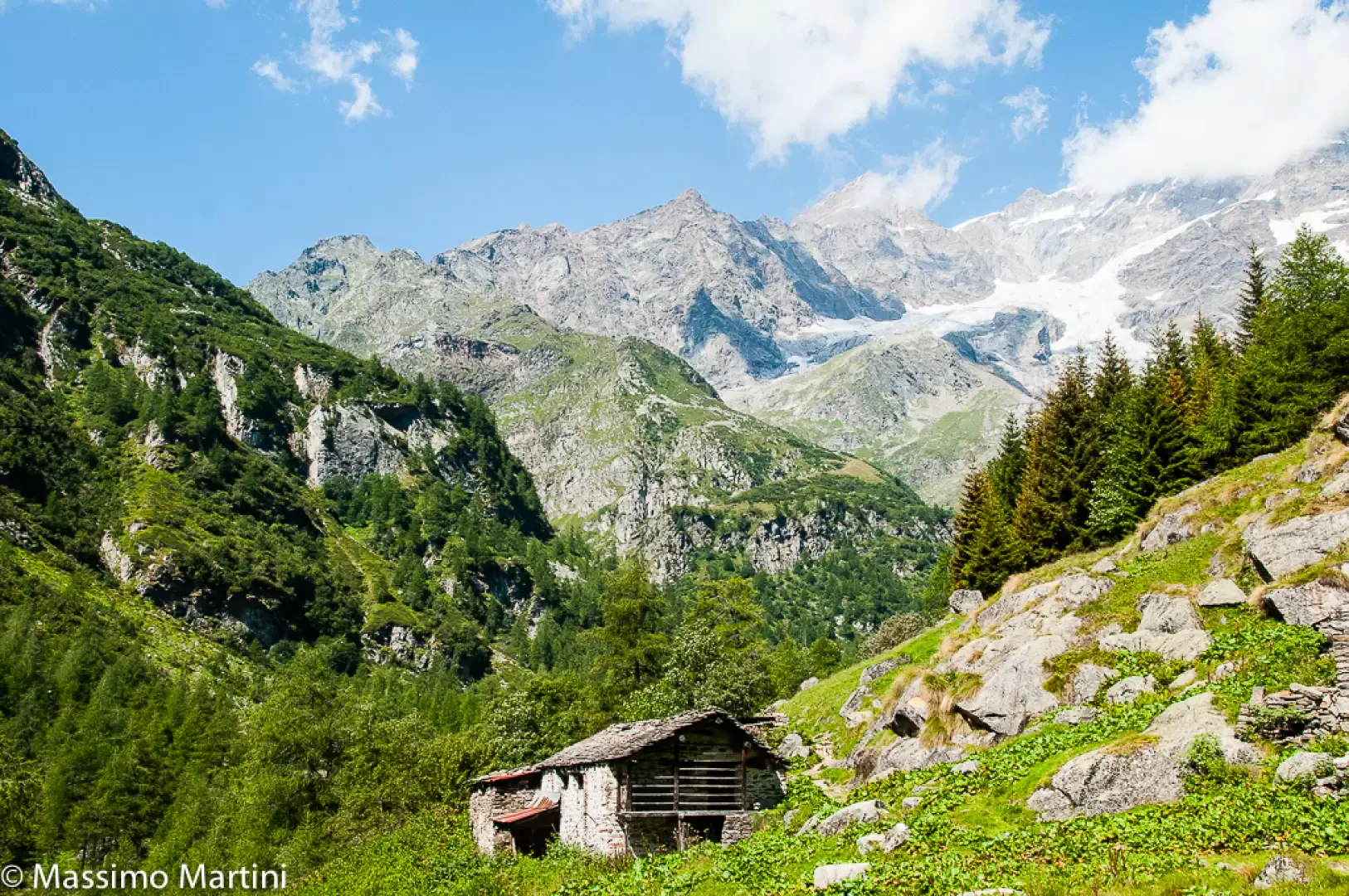
It is the highest park in Europe: its extreme borders reach Punta Gnifetti at 4559m, on Monte Rosa. It includes the head of the valleys of the River Sesia and its tributaries, the Sermenza, Egua, Mastallone and Landwasser streams, covering an area of approximately 6,500 hectares. The considerable difference in altitude, which starts at 900 m, gives rise to natural environments with very varied characteristics, starting with the thick forests at lower altitudes, moving on to the vast alpine meadows and ending with the glaciers on the southern slope of Monte Rosa: the Park has dedicated a self-guided glaciological trail to these in the Alagna area.
Natural Environment
The extreme variety of environments and the particular climatic situation favour the presence of a considerable number of plant species, subdivided by altimetrical bands. The lower altitudes host, among the forest associations, mixed forests of beech and silver fir. Other species, including sycamore maples, ash trees, birches, rowan trees, are among the best represented broadleaf trees; the subalpine plane is occupied almost entirely by larch with undergrowth of blueberries and rhododendrons. The cooler, north-facing slopes are home to extensive formations of green alder shrubs. Above 2000m, the survival of trees is limited: they make way for the vast alpine meadows, which, as they climb, thin out to become pioneer vegetation on cliffs and glaciers, including highly specialised plants. The richness of the plant landscapes provides excellent living conditions for a well-represented and particularly abundant fauna. The ibex, reintroduced in the early 1970s, has become a constant and established presence, as have the original animals such as chamois, roe deer, marmot, eagle, black grouse and other species typical of the alpine area. Their wide distribution allows them to be easily observed in almost all areas of the Park.
Environment Culture
Every corner of the Park bears the signs, sometimes very ancient, of the Timorese presence and the cultures that evolved or succeeded it. The first settlers from the high territories of Valsesia advanced to conquer new spaces for pastoralism, breeding and poor agriculture, building numerous settlements throughout the territory. Beginning in the 14th century, there was a migration of Germanic-speaking populations from Valais, the 'Walser', to the head of the valleys around the Monte Rosa massif. This phenomenon was an event that left an indelible mark on the territory. and local culture. The isolation of these populations has passed on to the present day important evidence of language, traditions and unique artefacts. The multiplicity and cultural liveliness of Valsesia is highlighted by a widespread and very rich artistic and craftsmanship activity that allowed the construction of valuable works present throughout the territory.
Information
Foundation Year: 1979
Area: 65.11 km2
Maximum elevation: Punta Gnifetti (4559m)
Municipalities concerned: Alagna Valsesia, Carcoforo, Fobello, Rima San Giuseppe, Rima, Rimella
Institutional site: www.areeprotettevallesesia.it
Contacts: info@areeprotettevallesesia.it