Gola della Rossa and Frasassi Park

Edited by:
Massimo Martini
Access
Introduction
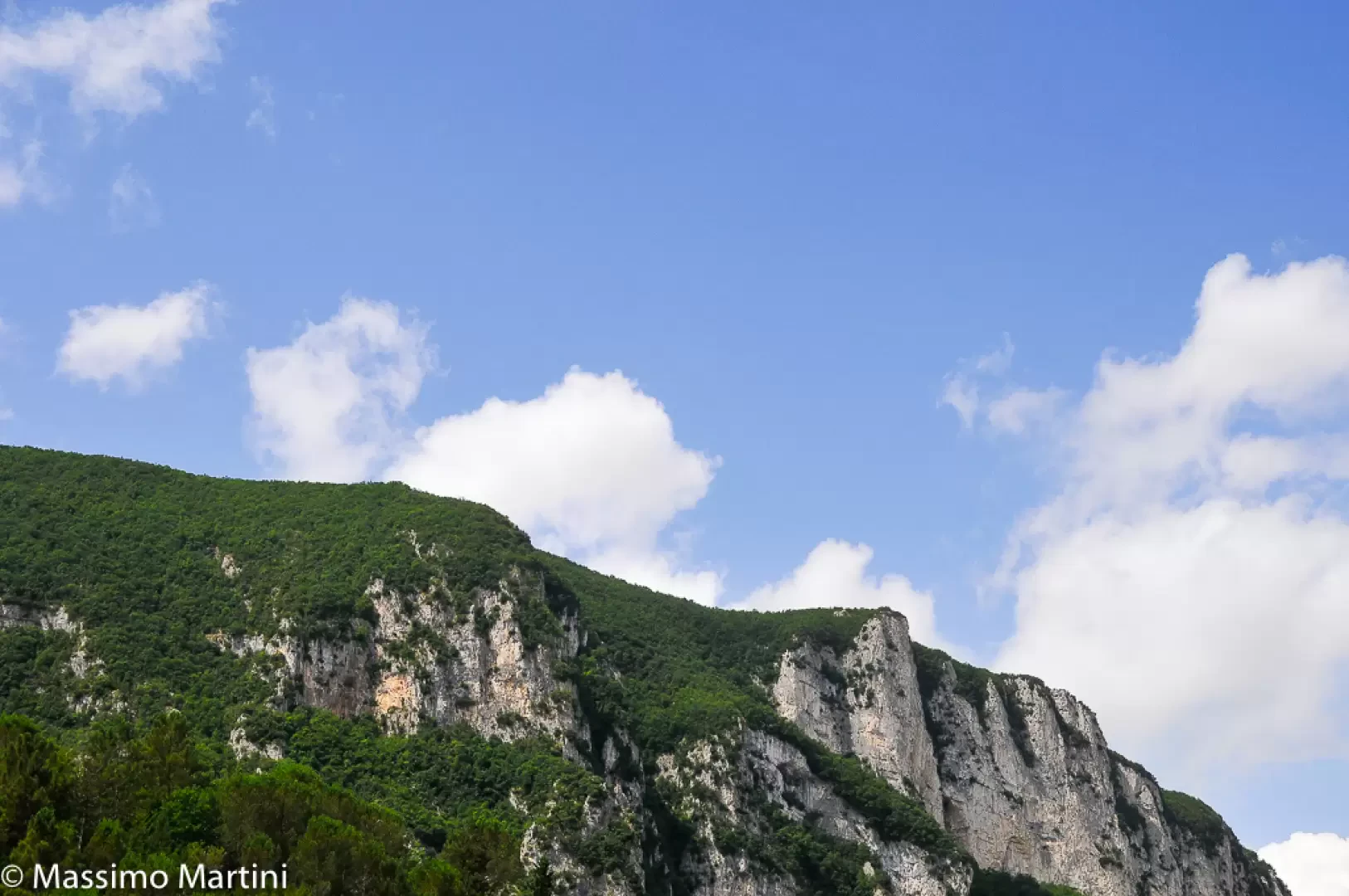
The Regional Natural Park of the Gola della Rossa and Frasassi is the 'green heart' of the Marche Region. Born in September 1997, with its 10026 hectares, it is the largest regional protected area and comprises three different biotopes: the Frasassi Gorge, the Gola della Rossa and the Valle Scappuccia. A trip to the Park is a 'journey into the heart of Le Marche', discovering historical and artistic treasures, hidden in landscapes full of charm and harmony, immersed in an intact and luxuriant nature.
Description
THE TERRITORY
The geology of the area is very characteristic: about a million years ago, a sudden increase in orogenic uplift increased the potential energy of the watercourses, which, by deeply incising the ridges, brought to light the massive limestone, so compact and rigid that it is preserved in imposing vertical blocks. The Frasassi ridge is today incised by the gorge of the same name, while the Monte Pietroso-Monte Murano structure is cut by the Gola della Rossa. The hollows and hilly areas, on the other hand, correspond to tectonic depressions and marly or clayey-arenaceous rocks, which are present above all in the northern sector of the park, which also shows evident relief.
The penetration of meteoritic and groundwater into the rock, widening the fractures, (thanks to the chemical corrosion favoured by the presence of dissolved carbon dioxide) in the eastern area of the Frasassi Gorge, causes deep sulphurous water to rise, generating a fluid that is extremely aggressive towards the limestone. These processes, interspersed with local collapses, rendered the dimensions of many hypogean chambers cyclopean, which present themselves as highly articulated karst complexes of extraordinary environmental-landscape value, as in the case of the famous Frasassi Caves.
Through a silent itinerary of about an hour, one can admire, with amazement, small lakes, stalactites and gigantic stalagmites, until reaching the majestic Ancona Abyss (240m high), the Sala delle Candeline, the Sala dell'Orsa and the Sala dell'Infinito. For some time now, there has been a water catchment of the sulphurous springs for use by the San Vittore thermal station, which uses them for therapies against respiratory and rheumatic ailments.
The Gola della Rossa is similar in appearance to that of Frasassi and contains large karstic cavities, including the Grotta del Vernino, where numerous interesting fossils of mammals such as the cave bear have been found.
The Scappuccia Valley, crossed by the Scappuccia stream that forms a rather narrow and sinuous gorge, is characterised by a variety of environments and therefore vegetation aspects conditioned by the substrate, exposure, altitude and the presence of water.
NATURE
The Park is a jewel of biodiversity with its 105 species of nesting birds, 40 mammals, 29 reptiles and amphibians and over 1250 plant species.
Among the birds, the golden eagle, which is at the top of a food web of mammals, birds, amphibians and crustaceans, should be mentioned in the first place; in the park, precisely in the Frasassi gorge, the only pair in the province of Ancona nests. Also significant is the presence of other diurnal birds of prey such as the goshawk, short-toed eagle, red kite, lanner and peregrine falcon, which nests in the area with at least three pairs.
Nocturnal birds of prey include the little owl, barn owl, tawny owl and the long-eared owl; the presence of the eagle owl has also been confirmed in a neighbouring area of the park.
Among the mammals, the presence of the wolf stands out. In recent decades, the wolf has recolonised the Marches ridge thanks to the demographic expansion of prey species such as wild boar, fallow deer, roe deer and red deer. The presence of the wild cat and the polecat, as well as the more common fox, weasel, beech marten and badger, is well known.
The numerous underground cavities in this area are populated by at least 12 different species of bats. The colonies of miniature bats in the park are among the most important in Europe, with more than 12,000 specimens present in both wintering sites and breeding nurseries. Among the cave-dwelling species, in addition to the Italic geotriton, an endemic species of the caves of central-northern Italy, the presence of the Niphargus ictus, a small endemic crustacean that populates the cave ponds, and other invertebrates such as Nesticus eremita, Meta merianae, etc., is remarkable.
In terms of time, in the calcareous sectors of the hilly plain, hornbeam forests are widespread, while on the marly-arenaceous ones, downy oak prevails.
In the mountainous plain and in particularly humid areas, beech forests develop, but on the warmer slopes of the rocky gorges, the vegetation is typically Mediterranean with holm oak, wild madder, terebinth, phillyrea, strawberry tree, asparagus and ragweed. In the summit areas of the territory there are extensive grassland formations of secondary origin that represent an ecosystem of great naturalistic interest due to the presence of rare or protected species under current national and international regulations. This habitat, rich in different species of the orchid family, derives from the cutting down of the forest by man since ep that remote time to obtain spaces useful for livestock breeding and grazing, for the practice of wine-making and for the cultivation of herbaceous and tree species of alimentary interest. In order to emphasise its conservation importance, in light of the tendency towards abandonment leading to its progressive disappearance due to natural processes of evolution, the European Union recognises secondary grasslands as having the highest level of conservation importance by identifying them as a 'priority' environment under the Habitats Directive.
Numerous very rare botanical species grow in the park, including the Moehringia papulosa, an endemic species of the Apennines, which can only be found in the Frasassi, Rossa and Furlo gorges, the Potentilla caulescens, the Saxifraga australis, an endemic species of the central and southern Apennines, and the Ephedra major, a relict of the Tertiary Era found on the rocks of the Scappuccia Valley.
TURIST OFFERING
The Park today offers a network of at least 35 signposted hiking trails, for a total of more than 170 km, of varying lengths and levels of difficulty, from tourist trails to those for expert hikers, which allow visitors to admire the gold and fauna typical of the pre-Apennine environment. It is also possible to practise other sports in contact with nature: mountain-biking on dirt tracks and cart-tracks distributed over tens of kilometres both at high altitudes and on the valley floor, horse-riding on the extensive network of mule tracks, mountaineering and sport climbing on the vertical limestone walls of the gorges and the main mountain ranges, speleology and, at certain times of the year, canoeing and rafting. In the Frasassi area there are some of the oldest traces of human presence (Grotta del Prete di Pianello di Genga). But the most numerous testimonies date back to medieval times: a dense network of castles, churches and monasteries of exceptional historical and artistic value. These include the Abbey of San Vittore alle Chiuse, founded in the ne 10th century, which was among the richest religious settlements in the area and one of the most important examples of Romanesque architecture in the Marche region. In addition, the Sanctuary of Santa Maria infra Saxa and the Tempietto, with an octagonal plan and dome, commissioned by Pope Leo XII to Giuseppe Valadier, located inside an immense cave; the Romanesque-style Abbey of Sant'Elena, located downstream of the Gola della Rossa, founded by San Romualdo at the beginning of the 11th century; the Abbey of Val di Castro, built at the beginning of the 11th century by order of San Romualdo who died there in 1027, which preserves interesting frescoes. Worth visiting are Fabriano, with its churches rich in works of art, the Art Gallery, the Paper and Watermark Museum, and Arcevia with its beautiful medieval historical centre. In the park, alongside the small castle villages of Avacelli, Castelletta, Pierosara, are the towns of Serra San Quirico with its 'copertelle', covered roads that served as a patrol path, and Genga, which still preserves its mediaeval urban structure, its city walls and the Palazzo dei Conti della Genga.
Information
Founding year: 1997
Area:10026 hectares
Maximum elevation:
Municipalities concerned: Arcevia, Cerreto d'Esi, Fabriano Genga, Serra San Quirico
Institutional site: www.parcogolarossa.it
Contacts: info@parcogolarossa.it