Val Grande Park

Edited by:
Massimo Martini
Access
The Val Grande National Park can be reached from the Genova-Gravellona Toce motorway, exiting at Verbania or Gravellona Toce, then continuing towards the municipalities where the park is located. From Milan, take the Simplon road to Verbania or the / via Gallarate. The headquarters of the Park Authority are in Vogogna (VB), Piazza Pretorio 6, Villa Biraghi. The main access points to the park on foot are: Cicogna (part of the municipality of Valle Cannobina), the only permanent village within the park; Premosello Chiovenda and Colloro for the southern side; Malesco and Santa Maria Maggiore for the northern side (Val Vigezzo); Intragna and Caprezzo for the eastern side. The park is only accessible on foot along trails - there are no carriage roads within the protected area - and its wildest parts can only be walked by experienced hikers with appropriate equipment, preferably in the company of mountain or environmental hiking guides. The railway connection for the northern side is the Vigezzina-Centovalli (Domodossola-Locarno) railway, which runs through the Vigezzo Valley with stops in Malesco, Santa Maria Maggiore and other villages. For the east and south side, the Novara-Domodossola line is used, with stops in Verbania and Ornavasso. The reference airport is Milan Malpensa.
.Introduction
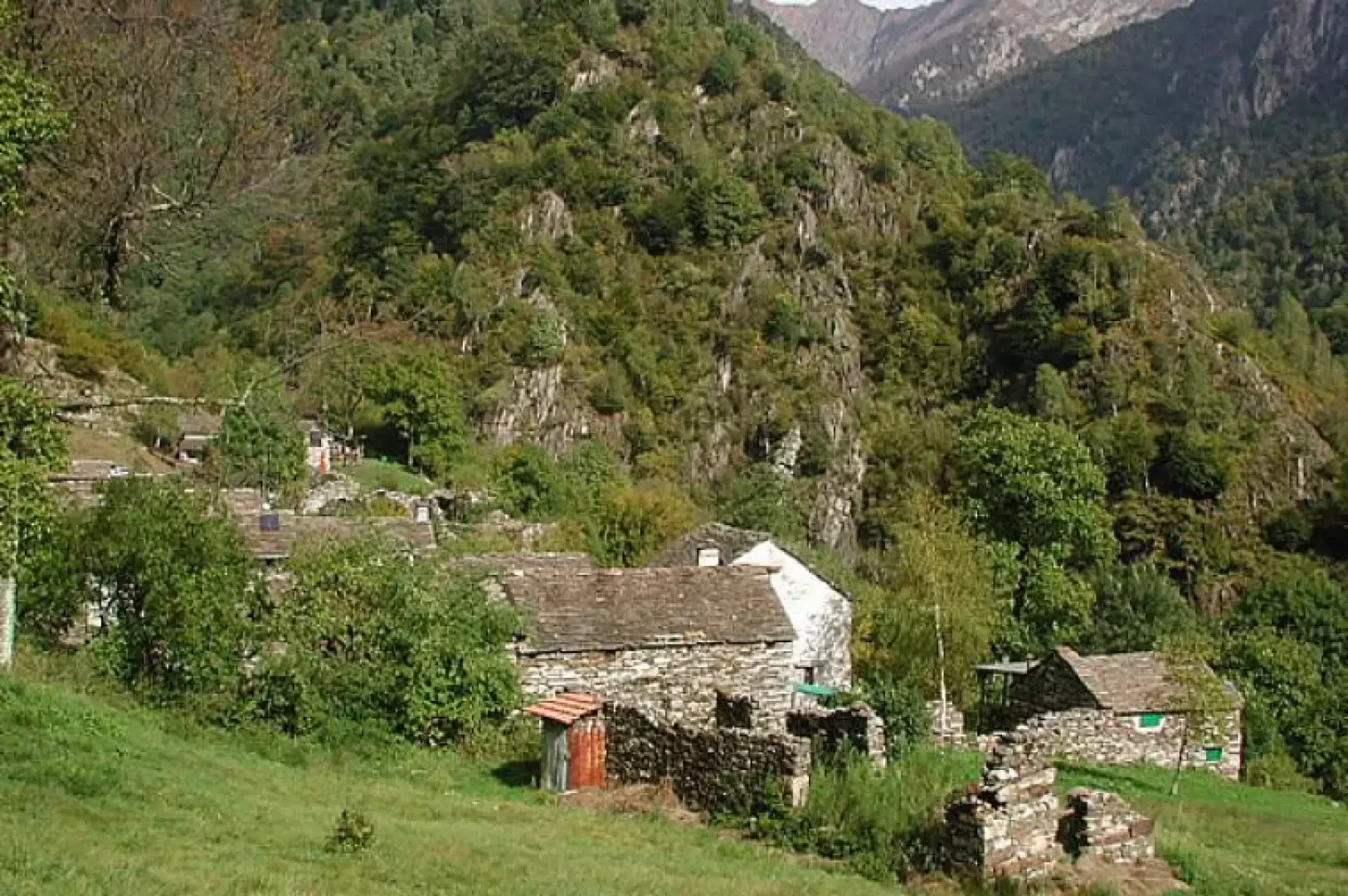
The Val Grande National Park is the largest wilderness area in the Italian Alps and Italy, entirely within the province of Verbano-Cusio-Ossola in Piedmont. Established by Ministerial Decree of 2 March 1992, published in the Gazzetta Ufficiale no. 99 of 29 April 1992, it was subsequently extended in 1998 and 2023, reaching an extension of 17,021 hectares over sixteen municipalities. The park coincides with the most impenetrable wilderness area in the south-western Alps: no carriage roads cross it, the permanent dwellings within it are reduced to the village of Cicogna - with only a few permanent residents - and spontaneous reforestation in the second half of the 20th century has returned to nature an area that had been worked by man for centuries. The World Wilderness Association has described it as "the only European wilderness area that fully preserves its original environmental characteristics". Previously, in 1967, the area of the Pedum rock massif was designated an Integral Nature Reserve - the first to be established in the Italian Alps. In 2018, the park became part of the Ticino Val Grande Verbano Biosphere Reserve, a UNESCO MAB recognition.
Description
The Val Grande lies between the southern spurs of the Lepontine Alps, in the transition zone between the Pennine Alps and the Rhaetian Alps, in a granitically compact territory that separates the plains of Lake Maggiore from the upper Val d'Ossola and Val Vigezzo. The relief is rugged and articulated: the main peaks are Monte Togano (2,310m), Cima della Laurasca (2,195m), Monte Zeda (2,157m) and Cima Pedum (2,111m). The territory varies from 400m at the valley floor to 2,310m at the peaks, with steep slopes, deep gorges, rushing torrents - the Rio Pogallo, Torrente Melezzo, Rio Valgrande - and the characteristic "piani" suspended high altitude plains such as Pian Cavallone at over 1,500m. The granite substratum results in acidic soils, scarcely fertile, colonised by rapidly expanding spontaneous vegetation: this is the key to the park's wilderness vocation.
The history of the Val Grande landscape is inseparable from the history of the men who inhabited and then abandoned it. Since at least the 13th century, shepherds and woodcutters have climbed the valleys every summer, cultivating mountain pastures, cutting timber and producing charcoal. In the early 20th century, the valley experienced a brief industrial season linked to the exploitation of timber by Swiss industrialist Carlo Sutermeister, who built the "Sutermeister Road" and Italy's first alternating current hydroelectric power plant in the Cossogno valley floor. The year 1944 marked a turning point: on 11 June, Nazi-Fascist forces launched the combing of the Val Grande - Operation "Köln" - with around 4,200 men including SS, Wehrmacht and RSI soldiers, with the aim of annihilating the partisan formations stationed in the valleys. At the end of the round-up, which ended on 27 June, around 300 partisans died, 208 huts and barns were burnt down and 42 prisoners were shot in Fondotoce (Verbania). With the end of the war, lumberjacks and mountain dwellers did not return; within fifty years, the forest regained possession of fields, mule tracks and mountain pastures, turning the valley into one of the most intact wilderness areas in the Alps. Three months after the round-up, the reorganised partisans liberated Domodossola, creating the Ossola Republic (September-October 1944), the first democratic experiment in occupied Italy.
The vegetation today is dominated by beech forests (Fagus sylvatica) on the wetter and shadier slopes, with silver fir (Abies alba) and Norway spruce (Picea abies) in the higher stations; birch, alder and other pioneer broadleaf trees occupy the glades and slopes with still unstable soils. The impenetrable thicket - the result of spontaneous reforestation - is one of the most striking features of the landscape. The flora includes many valuable species: arnica (Arnica montana), greater gentian (Gentiana lutea), campanula escissa (Campanula excisa - endemic to the Lepontine Alps), and wild orchids. The torrents are home to brown trout (Salmo trutta fario) and goby trout (Cottus gobio), indicators of high water quality. On the stony banks live the dipper (Cinclus cinclus) and the yellow wagtail (Motacilla cinerea).
The fauna is gradually being enriched by protection. The alpine chamois (Rupicapra rupicapra) is the most characteristic species in the park; red deer (Cervus elaphus) and roe deer (Capreolus capreolus) are expanding. The golden eagle (Aquila chrysaetos), peregrine falcon (Falco peregrinus), short-toed eagle (Circaetus gallicus), black grouse (Lyrurus tetrix) and black grouse (Tetrastes bonasia) are among the most prominent bird species; the eagle owl (Bubo bubo) is present. The wolf (Canis lupus italicus) has returned to the park: the first sightings in the Verbania area date back to the early 2000s, the first territorial pairs have been documented since 2019, and a stable presence has been confirmed since 2022. The return of the large predator, supported by the LIFE WolfAlps EU project, is considered an indicator of the ecological maturity of the ecosystem. Small mammals such as dormouse, beech marten and pine marten are widespread; weasels and ermine frequent the rocky areas.
Rupestrian engravings found in the area - one of which is featured in the park logo - and funerary objects in the necropolis of Malesco and Miazzina bear witness to settlements as far back as the Iron Age. The "mascherone" of Vogogna, a soapstone face of Celtic tradition dating back to the Second Iron Age (ca. 450-15 B.C.), is interpreted as a depiction of Cernunnos, a Celtic deity of the wilderness. The park also offers the Cadorna Line - a defence system from the First World War that can be walked along the ridges - and the partisan paths of the Resistance. The Sentiero del Pellegrino (Pilgrim's Path), an ancient path of shepherds and wayfarers, crosses the valley with views of the surrounding mountains. The Alta Via Val Grande is the park's main loop trail.
.Information
General Data
Typology: National Park; UNESCO MAB Biosphere Reserve (from 2018, Ticino Val Grande Verbano Biosphere Reserve)
Year of establishment: 1992 (D.M. 2 March 1992; G.U. no. 99 of 29 April 1992); park authority: D.P.R. 23 November 1993; enlargement: D.P.R. 24 June 1998; enlargement 2023: D.P.R. 2023 (G.U. no. 238 of 11 October 2023); Val Grande Integral Nature Reserve (previous): 1967; UNESCO MAB Biosphere Reserve: 2018
Managing body: Val Grande National Park Authority
Reference body: Ministry of the Environment and Energy Security
Area: 170.21 km² (17.021 ha; of which 11,971 ha SPA)
Minimum elevation: ~400m
Maximum elevation: 2,310m
Maximum elevation: 2,310m - Monte Togano (Valle Cannobina VB)
Region(s): Piedmont
Province: Verbano-Cusio-Ossola
Municipalities involved: Aurano - Beura-Cardezza - Caprezzo - Cossogno - Intragna - Malesco - Mergozzo - Miazzina - Ornavasso - Premosello Chiovenda - San Bernardino Verbano - Santa Maria Maggiore - Trontano - Valle Cannobina - Verbania - Vogogna
Official website: https://www.parcovalgrande.it