Sibillini Mountains Park

Edited by:
Massimo Martini
Access
The Monti Sibillini National Park can be reached from several directions depending on the side of access. The eastern side of the Marche region can be reached by taking the Adriatica motorway, exiting at San Benedetto del Tronto and continuing towards Ascoli Piceno and then the inland valleys (Aso, Tenna, Ambro); alternatively, it can be accessed from Civitanova Marche by following the Val di Chienti state road towards Macerata and Camerino. The western side of Umbria can be accessed from the Milan-Naples motorway, exiting at Orte or Bettolle to reach Foligno, Spoleto and Norcia via the and the Valnerina; or from Perugia towards Foligno. The Park Authority headquarters is located in Visso (MC), in Piazza del Forno 1. The main access gates are: Norcia (Umbria) for the Piani di Castelluccio and the western slope; Arquata del Tronto (AP) and Castelsantangelo sul Nera (MC) for the southern Marche slope; Amandola (FM) for the northern Marche slope; Visso and Ussita (MC) for the central slope. The nearest airport for the Marche side is Ancona-Falconara; for the Umbria side it is Perugia or Rome. The nearest railway stations are Ascoli Piceno (then bus) for the Marche side and Spoleto or Foligno (then bus) for the Umbrian side. During the flowering of the Piani di Castelluccio (late spring-early summer), access with private vehicles is regulated by a sustainable mobility plan with shuttles from the peripheral car parks on Sundays when there is a greater influx; check the updated restrictions on the park website.
.Introduction
The Monti Sibillini National Park extends between the Marches and Umbria, in the provinces of Ascoli Piceno, Fermo, Macerata and Perugia, covering an area of approximately 714.37 km² distributed over eighteen municipalities. Established by the Presidential Decree of 6 August 1993, published in the Gazzetta Ufficiale no. 275 of 23 November 1993, it protects the limestone massif of the same name - the fourth highest in the continental Apennines after Gran Sasso, Majella and Velino-Sirente - with more than twenty peaks over 2,000m and the highest peak of Monte Vettore at 2,476m. The park is characterised by the presence of three extraordinary environments: the Piani di Castelluccio, a high-altitude karst plateau famous for the summer blooming of lentils and wild flowers; the Lago di Pilato (1.941m), the only alpine-type glacial basin in the Apennines and habitat of the absolute endemism Chirocephalus marchesonii; the Gole dell'Infernaccio, one of the deepest canyons in the Marche region. The territory is also shrouded in a rich legendary heritage linked to the figure of the Apennine Sibyl and Pontius Pilate, which has connoted its mysterious character for centuries.
.Description
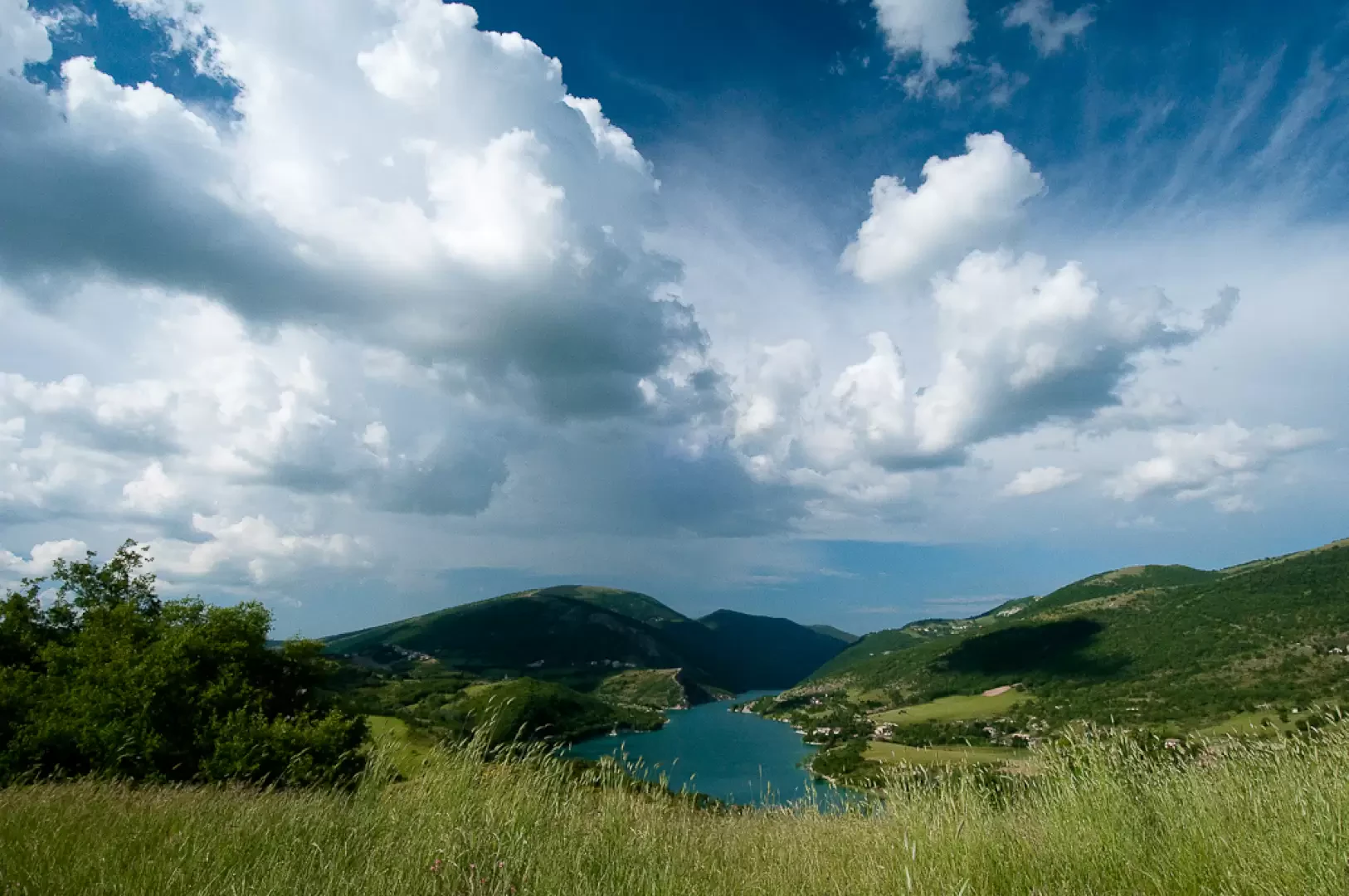
The Monti Sibillini massif is a calcareous-dolomitic complex of Mesozoic origin, profoundly modelled by Quaternary glaciers that hollowed out glacial cirques, "U" valleys and moraine deposits. Karst phenomena are particularly evident throughout the area and especially in the Piani di Castelluccio. Two opposite slopes branch off from the main axis of the Apennine ridge: the eastern one, facing the Marche region, is cut by narrow, north-facing valleys (the valleys of the Aso, Tenna and Ambro) with impressive gorges such as the Gole dell'Infernaccio on the Tenna torrent and the Gola di Fiastrone; the western one, towards Umbria, instead, has three characteristic high-altitude karst depressions - Pian Grande, Pian Piccolo and Pian Perduto - that form the Castelluccio plateau at about 1.400m above sea level. The main peaks are Mount Vettore (2,476m), Cima del Redentore (2,448m), Mount Priora (2,332m), Pizzo Tre Vescovi (2,090m) and Mount Sibilla (2,175m), which gives its name to the entire massif. Lago di Pilato (1,941m) lies in a glacial cirque below the summit of Monte Vettore: it is the only alpine-type glacial lake in the Apennines. Its waters are home to the Chirocephalus marchesonii, a small red-orange crustacean 9-12mm long that swims with its belly upwards, an absolute world endemism found exclusively in this lake - its blood, according to medieval legend, gives the lake its famous reddish colour - discovered and described by botanist Vittorio Marchesoni of the University of Camerino. The lake has been suffering since 2017 from increasingly frequent episodes of summer drying up, attributed both to climate change and to the increased permeability of the bottom caused by the 2016 earthquake. Lake Fiastra, which is artificial, is the main body of water on the Marches slope.
The flora has about 1,800 species, with Apennine edelweiss, alpine anemone, cushion silene, Eugenia violet, Apennine gentian, artemisia petrosa and numerous orchids; alpine linaria and Apennine ribwort grow in the scree and scree areas. The vegetation follows well-defined altimetrical belts: oak, black hornbeam and manna ash forests up to 1,000m, beech forests (Fagus sylvatica) at first mixed then pure up to 1,700-1,800m, and high-altitude primary pastures with rare species beyond the forest. The Piani di Castelluccio are home to the cultivation of the Lenticchia di Castelluccio PGI, a late-ripening high-altitude legume that produces the famous summer flowering: between the end of June and the first half of July, the fields are covered with white, red, yellow and purple flowers of lentils, poppies, cornflowers, wild violets and other wild plants, in a chromatic mosaic attracting millions of visitors.
The fauna includes 50 species of mammals, 150 species of birds and over 20 species of reptiles and amphibians. The Apennine wolf (Canis lupus italicus) has one of the northernmost ranges in the Sibillini Mountains. The Marsican brown bear (Ursus arctos marsicanus) has returned to frequent these mountains. The Apennine chamois (Rupicapra pyrenaica ornata) and deer (Cervus elaphus) have been reintroduced with specific park projects and are now present with growing populations. The roe deer is distributed throughout the territory; the porcupine (Hystrix cristata) occupies the more thermophilic hilly areas. Birds include the golden eagle (Aquila chrysaetos) - which, since the park was established, has begun to nest again, even in areas that had been abandoned for years - the peregrine falcon (Falco peregrinus), the eagle owl (Bubo bubo), the alpine and coral chough (Pyrrhocorax graculus and P. pyrrhocorax), the turtle plover (Charadrius morinellus), the rufous-tailed rock thrush, the mute and the wallcreeper complete the picture of the most significant vertebrates. Among the reptiles, the Orsini's viper (Vipera ursinii) in the high-altitude pastures is worth mentioning.
The area is steeped in history and legend. Near Mount Sibilla, the legend of the Apennine Sibyl, a priestess-prophetess who is said to have inhabited a cave in the rock, has been handed down for centuries: between the Middle Ages and the Renaissance, the myth attracted pilgrims, necromancers and seekers of the "Paradise of the Sibyl" from all over Europe. The Lake of Pilate owes its name to the story that the cart with the body of Pontius Pilate - condemned to death by the emperor - was dragged by buffaloes into the lake. Heretics and brigands found refuge in these valleys over the centuries, fuelling a reputation as a mysterious and inaccessible land. Norcia - a municipality in the park on Umbrian territory - is the birthplace of St Benedict of Norcia (480-547 A.D.), founder of the Benedictine Order and patron saint of Europe; the Basilica of St Benedict, severely damaged in the 2016 earthquake, is currently being restored. The Central Italy earthquake of 24 August and 30 October 2016 severely affected the park's territory, devastating Norcia, Ussita, Visso, Castelluccio di Norcia and the Marche municipalities of Arquata del Tronto and Montegallo; reconstruction is still in progress. The park footpaths cover about 500 km, with the "Grande Via dei Sibillini" itinerary of more than 190 km, which can be travelled by car, motorbike and camper van, and hiking and biking trails.
.Information
General Data
Typology: National Park
Institution year: 1993 (D.P.R. 6 August 1993; G.U. n. 275 of 23 November 1993); perimeter: D.M. 3 February 1990
Managing body: Ente Parco Nazionale dei Monti Sibillini
Reference body: Ministero dell'Ambiente e della Sicurezza Energetica
Area: 714,37 km²
Minimum altitude: ~300m
Maximum altitude: 2.476m
Maximum elevation: 2.476m - Monte Vettore (Montemonaco AP / Arquata del Tronto AP)
Region(s): Marche - Umbria
Provinces: Ascoli Piceno - Fermo - Macerata - Perugia
Municipalities concerned - Marches, Province of Ascoli Piceno (AP): Arquata del Tronto - Montegallo - Montemonaco
Municipalities concerned - Marches, Province of Fermo (FM): Amandola - Montefortino
Municipalities concerned - Marche, Province of Macerata (MC): Acquacanina - Bolognola - Castelsantangelo sul Nera - Cessapalombo - Fiastra - Fiordimonte - Pieve Torina - Pievebovigliana - San Ginesio - Ussita - Visso
Municipalities concerned - Umbria, Province of Perugia (PG): Norcia - Preci
Official website: https://www.sibillini.net