Tuscan-Emilian Apennine Park

Edited by:
Massimo Martini
Access
The Parco Nazionale dell'Appennino Tosco-Emiliano can be reached from the north along the Milano-Napoli motorway, with the Parma Sud and Reggio Emilia tollbooths, from which it is possible to ascend towards the Apennine ridge along the SS della Cisa state road in the direction of Sarzana - the main road on the Emilia side of the park - or by using the Parma-La Spezia motorway, with the Pontremoli exit;A15]v Parma-La Spezia motorway with exit at Pontremoli, useful for reaching the Tuscan side through Lunigiana. On the Tuscan side, access from the Garfagnana is via the Garfagnana state road up the Serchio valley from Lucca; from the Lunigiana via the Cisa state road from Sarzana in the direction of Parma. The Park Authority headquarters are in Sassalbo di Fivizzano (MS), Via Comunale 23; an operations office is located in Cervarezza Terme di Busana (RE), Piazza I° Maggio 3. The visitor centres - ten in all - are distributed on both sides: the most accessible are located at the Orecchiella State Reserve (San Romano in Garfagnana), Castelnovo ne' Monti and Fivizzano. The Reggio Emilia railway station is the main railway junction for the Emilian side; the Aulla Lunigiana station, on the La Spezia-Parma line, serves the Tuscan-Ligurian side with Trenitalia (TI). In winter, some secondary roads on the ridge may be impassable due to snow.
Introduction
The Parco Nazionale dell'Appennino Tosco-Emiliano extends along the Apennine ridge on the border between Emilia-Romagna and Tuscany, in the provinces of Parma, Reggio Emilia, Lucca and Massa-Carrara, between the Cisa and Forbici passes. Established by Presidential Decree of 21 May 2001 - published in the Gazzetta Ufficiale on 26 October 2001 - it covers an area of approximately 261.49 km² distributed over thirteen municipalities. Since June 2015, the park territory has been included in the UNESCO MAB Biosphere Reserve of the Tuscan-Emilian Apennines, an area of over 2,300 km² stretching from the Cisa Pass to the Radici Pass. The park was created from the unification of pre-existing protected areas - the Giant and Hundred Lakes Regional Parks and four state nature reserves - with portions of territory not yet protected. The ridge that runs through it constitutes the climatic boundary between the Po-Emilian continental domain and the Tyrrhenian-Mediterranean domain, a condition that determines an exceptional diversity of species: the perimeter of the Biosphere Reserve contains more than 70% of Italian biodiversity.
Description
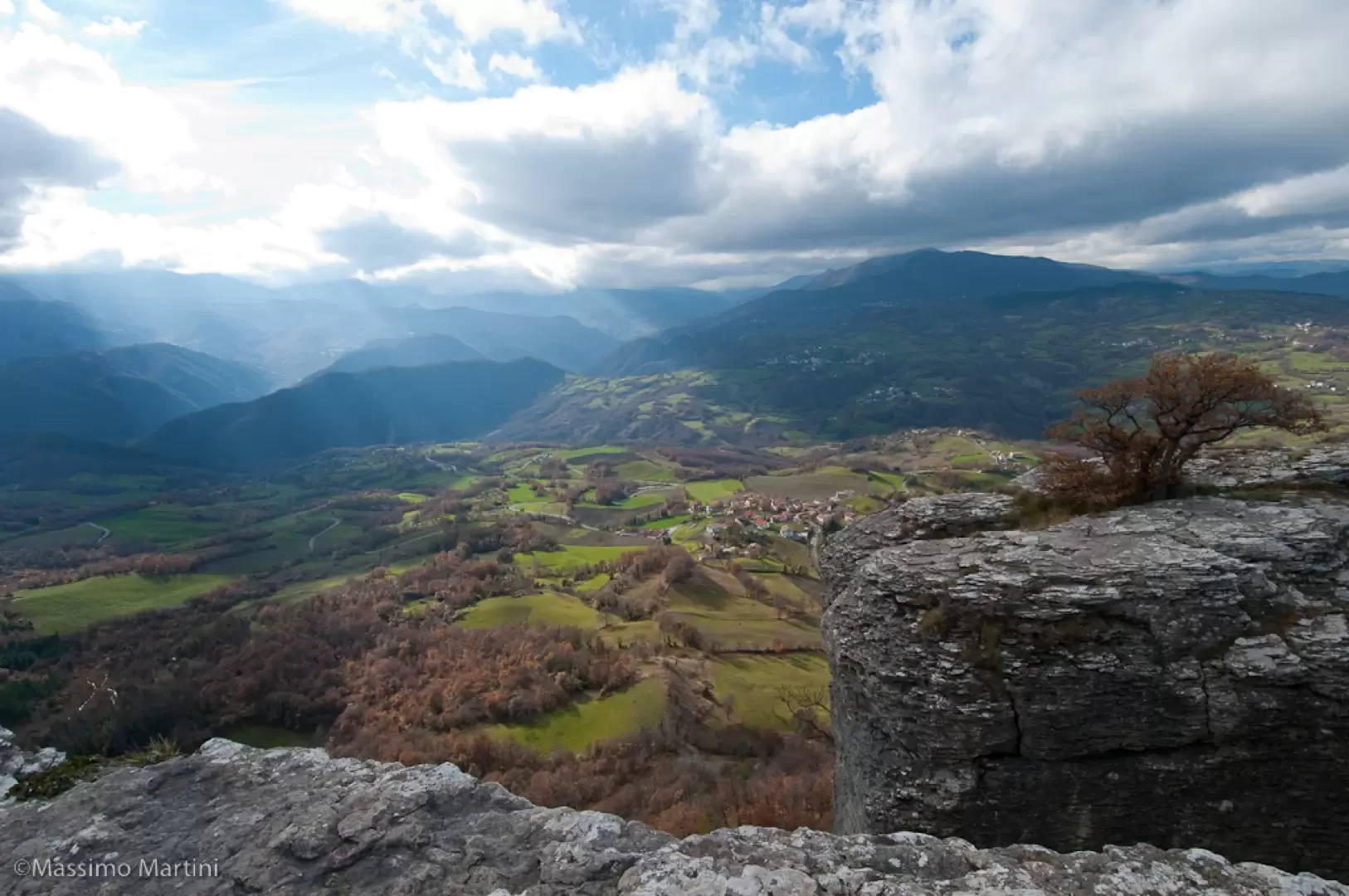
The park occupies an approximately 60 km stretch of Apennine ridge that separates the Po plains from the Tuscan valleys, with altitudes gradually rising from the hilly valley bottoms to altitudes above 2.000m of the three highest peaks: Monte Cusna (2,121m), the highest peak in the Reggio Emilia Apennines and second in the entire northern Apennines; Monte Prado (2,053m), the first peak in Tuscany; and Alpe di Succiso (2,017m). The orographic system also includes Monte la Nuda (1,832m), Monte Marmagna (1,851m), Monte Orsaro (1,830m), Monte Ventasso (1,727m) and Pania di Corfino (1,603m). Off the main ridge, the Pietra di Bismantova (1,041m) - a limestone mesa with vertical walls that rises isolated above the Secchia River in the municipality of Castelnovo ne' Monti - is the most characteristic geological formation in the Emilian area of the park. The geology of the territory is particularly varied: the prevailing calcareous-arenaceous formations are flanked by the Triassic chalks of the Secchia Valley, flysch and clays of the Ligurian-Tuscan-Emilian side, with glacial morphologies still recognisable in the shapes of the cirques, moraines and high-altitude lakes of the Reggio Emilia and Parma sectors. The main watercourses on the Emilia side are the Secchia, Enza, Parma and Cedra; on the Tuscan side run the Taverone and Rosaro, tributaries of the Magra.
The vegetation presents a complete altitudinal zonation. In the lower hills are chestnut groves, mixed oak and downy oak (Quercus pubescens); between 800m and 1.Between 800m and 1,700m, beech woods (Fagus sylvatica) are the dominant cover, with nuclei of silver fir (Abies alba) - rare in the Apennines - found in the Valle di Dolo fir woods (Alta Val Cedra, Monchio delle Corti), in the Abetina Reale fir woods of the Upper Apennines in the province of Reggio Emilia, on Mount La Nuda and Mount Ventasso. Blueberry heaths (Vaccinium myrtillus) characterise the supra-forest belt of the northern Apennines, above the upper limit of the beech forest. Glacial relicts such as the Apennine primrose (Primula apennina Ten.), endemic to this section of the Apennines, the alpine crotonella, the herbaceous willow and the heather baccinifera can be found on the summit meadows. The flora of the park has a total of over 2,000 species, with several endemics including Vicia cusnae, Festuca riccerii and Brachypodium genuense. The marmot (Marmota marmota), introduced in recent decades on some high-altitude meadows, has become firmly established and has favoured the increase in pairs of golden eagles (Aquila chrysaetos), which find it a main prey.
The fauna includes the Apennine wolf (Canis lupus italicus), present in several herds on both sides of the ridge thanks to the conservation policies implemented in recent decades; the red deer (Cervus elaphus) and roe deer (Capreolus capreolus), successfully reintroduced; the wild boar and the mouflon (Ovis aries musimon). Birds of prey include the golden eagle, peregrine falcon (Peregrine falcon) and short-toed eagle (Circaetus gallicus). The high altitude wetlands are home to the alpine newt (Ichthyosaura alpestris), a glacial relict at the southern limit of its Apennine range. The park is bordered by four state nature reserves - Pania di Corfino, Guadine Pradaccio, Lamarossa and Orecchiella - that extend its conservation value towards the Tuscan and Parma sectors.
The Apennine ridge has for millennia represented the contact hinge between the Po and Tyrrhenian civilisations. The Lagastrello, Cerreto, Pradarena and Radici passes have been routes of transit and commercial, cultural and ethnic exchange since ancient times, and their historical importance is testified by the presence of medieval defence fortresses - including the Verrucole Fortress in San Romano in Garfagnana - and a dense network of Romanesque churches, parish churches and paved roads. The tegge, rural stone and straw buildings typical of the valleys of the Reggiano region, document the agro-pastoral culture at high altitudes. The park was established with the Presidential Decree of 21 May 2001 pursuant to Law No. 344 of 8 October 1997, which provided for the allocation of resources for the creation of new national parks, unifying two regional parks - Parco del Gigante (RE) and Parco dei Cento Laghi (PR) - with the state nature reserves of Orecchiella, Guadine Pradaccio, Lamarossa and Pania di Corfino and with territories not yet protected. Recognition as a UNESCO MAB Biosphere Reserve, obtained in June 2015, covers an area of over 230,000 hectares around the ridge between the Cisa Pass and the Passo delle Radici, with a perimeter that includes the Garfagnana and Lunigiana on the Tuscan side and the Enza, Secchia and Parma valleys on the Emilia side.
The park's trail network includes an extensive system of marked trails, including the Via Matildica del Volto Santo, a historical-religious itinerary on the Emilia-Tuscan ridge, and numerous thematic routes linked to geological emergencies, glacial lakes and historic villages. The refuges and bivouacs distributed along the ridge - including the Mattei Refuge, the Mariotti Refuge and the Capanna Tifoni in the Parma-Reggios sector - offer logistical support for high-altitude hiking and trekking. The Pania del Corfino Botanical Garden in Villa Collemandina is a centre for the study and conservation of Apennine flora. The agri-food products of the area - Parmigiano Reggiano and Prosciutto di Parma on the Emilia side, honey and dairy products on the Tuscan side - are an integral part of the park's cultural identity and are promoted as part of the Biosphere Reserve.
Information
General Data
Typology: National Park; UNESCO MAB Biosphere Reserve (since June 2015)
Year of Establishment: 2001 (Presidential Decree 21 May 2001; Official Gazette no. 250 of 26 October 2001); UNESCO MAB Biosphere Reserve: 2015
Managing body: Ente Parco Nazionale dell'Appennino Tosco-Emiliano
Reference body: Ministero dell'Ambiente e della Sicurezza Energetica
Area: 261.49 km²
Buffer zone / contiguous area: UNESCO MAB Biosphere Reserve: approx. 2,300 km²
Minimum elevation: [to be completed]
Maximum elevation: 2,121m
Maximum elevation: 2,121m - Monte Cusna (Ventasso / Villa Minozzo, RE)
Region/s: Emilia-Romagna - Tuscany
Province(s): Lucca - Massa-Carrara - Parma - Reggio Emilia
Municipalities involved: Bagnone - Castelnovo ne' Monti - Comano - Corniglio - Filattiera - Fivizzano - Licciana Nardi - Monchio delle Corti - San Romano in Garfagnana - Sillano Giuncugnano - Ventasso - Villa Collemandina - Villa Minozzo
Official website: https://www.parcoappennino.it