Punta Sella

Edited by:
Massimo Martini
Access
The ascent to Punta Sella is generally carried out from Pian Coumarial (Fontainemore) following path (E, approx. 2h 45' to the Coda hut + 10' to the summit), which has well-marked characteristics of a classic alpine path: moderate gradients, paved sections, crossings of streams and pastures, with very few technical difficulties in the absence of snow. From the Piedmont side, the Coda hut can be reached via Alpe S.Giovanni di Oropa (Pollone) following the GTA, which is also suitable for moderately experienced hikers (T3). There are possible ridge variants and short equipped traverses for the more experienced (EE/F). Climbing itineraries and mountaineering variants, although less frequent than on the surrounding peaks, are documented at CAI Biella sources and local guides. The winter climbs are mainly practised by ski mountaineering and snowshoeing enthusiasts, with established routes but subject to evaluation of snow and slope conditions.
- normal route from Coumarial with path 3
Introduction
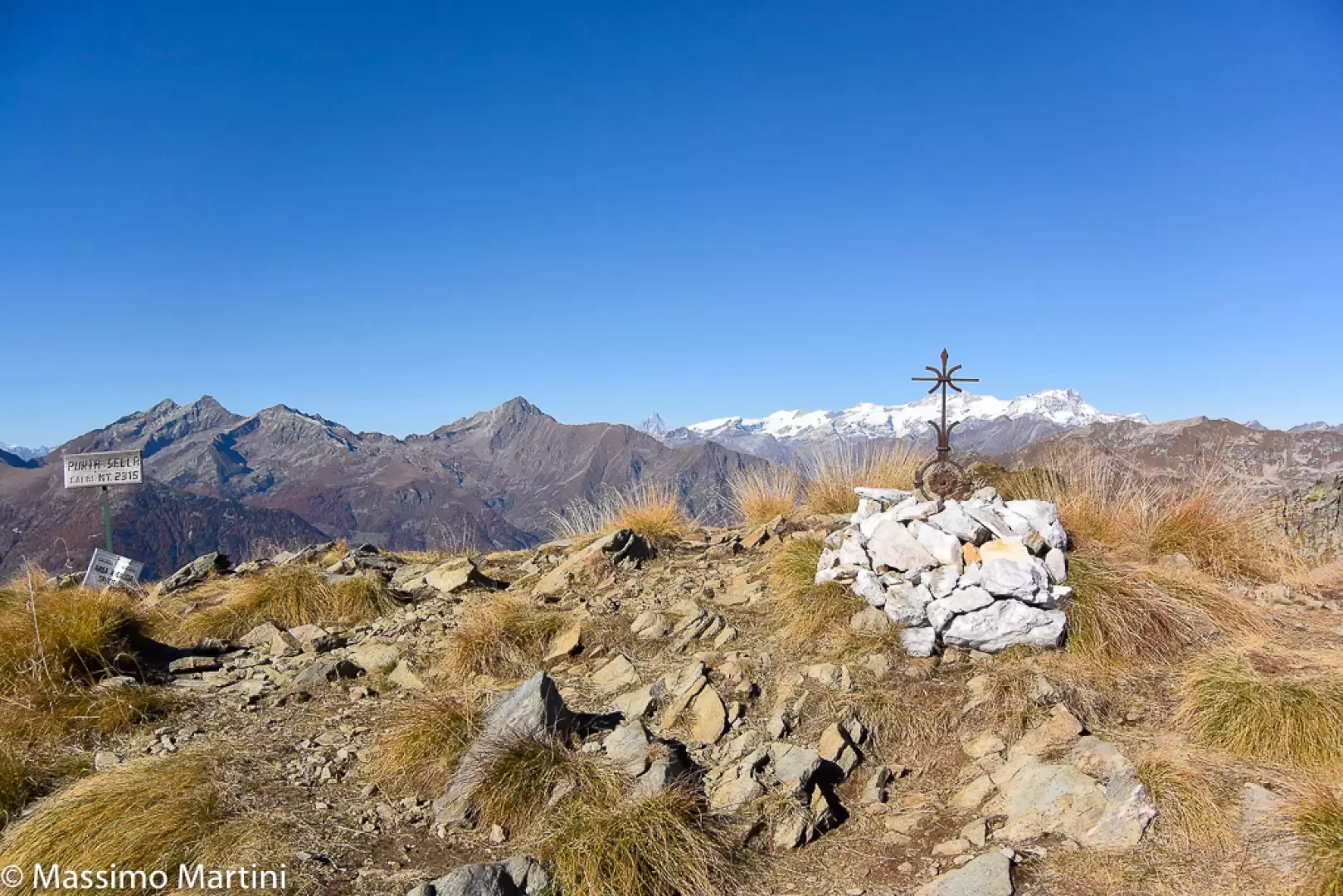
Punta Sella rises to 2,315 metres along the watershed ridge between Piedmont and Valle d'Aosta, marking the administrative boundary between the municipalities of Pollone and Fontainemore. It is a landmark peak in the Biellese-Canavese Alps, set in a panoramic position on the Carisey-Mars Ridge, crowning and dominating the upper Val d'Issime, the basin of Lake Goudin and the vast pastures sloping towards Oropa. Its clear profile and position as a natural belvedere make it a popular stop for hikers and Alpine history enthusiasts alike, representing one of the privileged observatories of the highest peaks in Valle d'Aosta and Piedmont.
Description
The first frequentations of Punta Sella are part of the late 19th century explorations, mainly linked to the pioneering tourism that developed around the Sanctuary of Oropa and the Biella area. Hiking activity was consolidated with the construction, just below the summit, of the Rifugio Coda after World War II, which facilitated ridge crossings and the first experiences of ascents on snow-covered terrain. There is no record of a 'real' first official ascent, as the mountain had already been reached by local shepherds and valley dwellers. The historical ascents of the first hikers, who were succeeded in later years by those who traced and extended the trails in the area, helped to consolidate Punta Sella's fame as a hiking destination and intermediate support point for ascents to Mont Mars. Among other curiosities, it should be noted that the peak was considered, by the people of Oropa and Fontainemore, a border place and symbol of the meeting point between "Biellese Piedmont" and "Aosta Valley", with some recurring territorial disputes over grazing areas.
Gographically speaking, Punta Sella represents the orographic junction between the basin of Lake Goudin to the north (Valle d'Aosta) and the Oropa pasture slope (Piedmont) to the south, in an environment dominated by alpine grasslands, glacial moraines and isolated outcrops of serpentinites and gneiss. The climate is typically alpine, with long, snowy winters lasting until early June and a period favourable to ascents concentrated between mid-June and mid-October. The environmental peculiarities of the area include the rich variety of alpine species (gentians, rhododendrons, various saxifrages), the presence of marmots and birds of prey at high altitudes, and the possibility of admiring, from a single position, the main mountains of Piedmont and Valle d'Aosta as far as the Rosa and Bianco ranges. The toponym 'Punta Sella' probably alludes to its saddle shape or to its function as a natural pass between the slopes, although some local sources symbolically link it to the figure of Quintino Sella, a Piedmontese statesman and mountaineer originally from Biella, whose memory is linked to the area's support shelters and to the early glory of the Italian Alpine Club. For the local communities, the peak represents not only an excursion objective, but also an identity reference point and a place frequented for festivities, propitiatory rites and ancient transhumance traditions; there is no lack of legends about the apparitions of mysterious figures along the ridge during summer storms, later transposed into Alpine folklore.
Information
Quota: 2315m
Alternative name: -
Mountain group: Three Bishops-Mars Range
First ascension:
First ascents in winter:
First ascents in winter: