Sanctuary of Oropa

Edited by:
Maria Grazia Schiapparelli
Introduction
The Sanctuary of Oropa is one of the most important Marian shrines in the Alps. Inside it a Black Madonna is venerated, which tradition says was brought here by Bishop Eusebius from Palestine; there should have been three statues, sculpted by St. Luke: one is in the cathedral of Cagliari, Eusebius's homeland, one at the Sanctuary of Crea, the other was probably destined for the cathedral of Vercelli, but Bishop Eusebius had to take refuge in the Oropa mountains following the Arian persecutions and brought the statue here, hiding it in a niche in an erratic boulder, the one in the Dal Roc chapel, on the road to the Rosazza tunnel, which bears the date 369 engraved on it.
Description
The Roc (stone) used to be on the other side of the Oropa stream, while now it is on its orographic right, because the riverbed was diverted to build the New Church. In those days, fording the stream was not always easy, so the statue was brought to this side of the stream to a sacellum built at that time, on which the present-day Basilica Vecchia was later built; a few hermits settled near the statue and the priory of Santa Maria was established, while about 200 metres lower down, the priory of San Bartolomeo was established, recently transformed into a farmstead, but in whose premises ancient frescoes have recently been discovered. The first church was consecrated in 1294 by the Bishop of Vercelli, Aimone di Challant, who was originally from Valle d'Aosta, and the people of Valle d'Aosta have always been very attached to the Sanctuary.
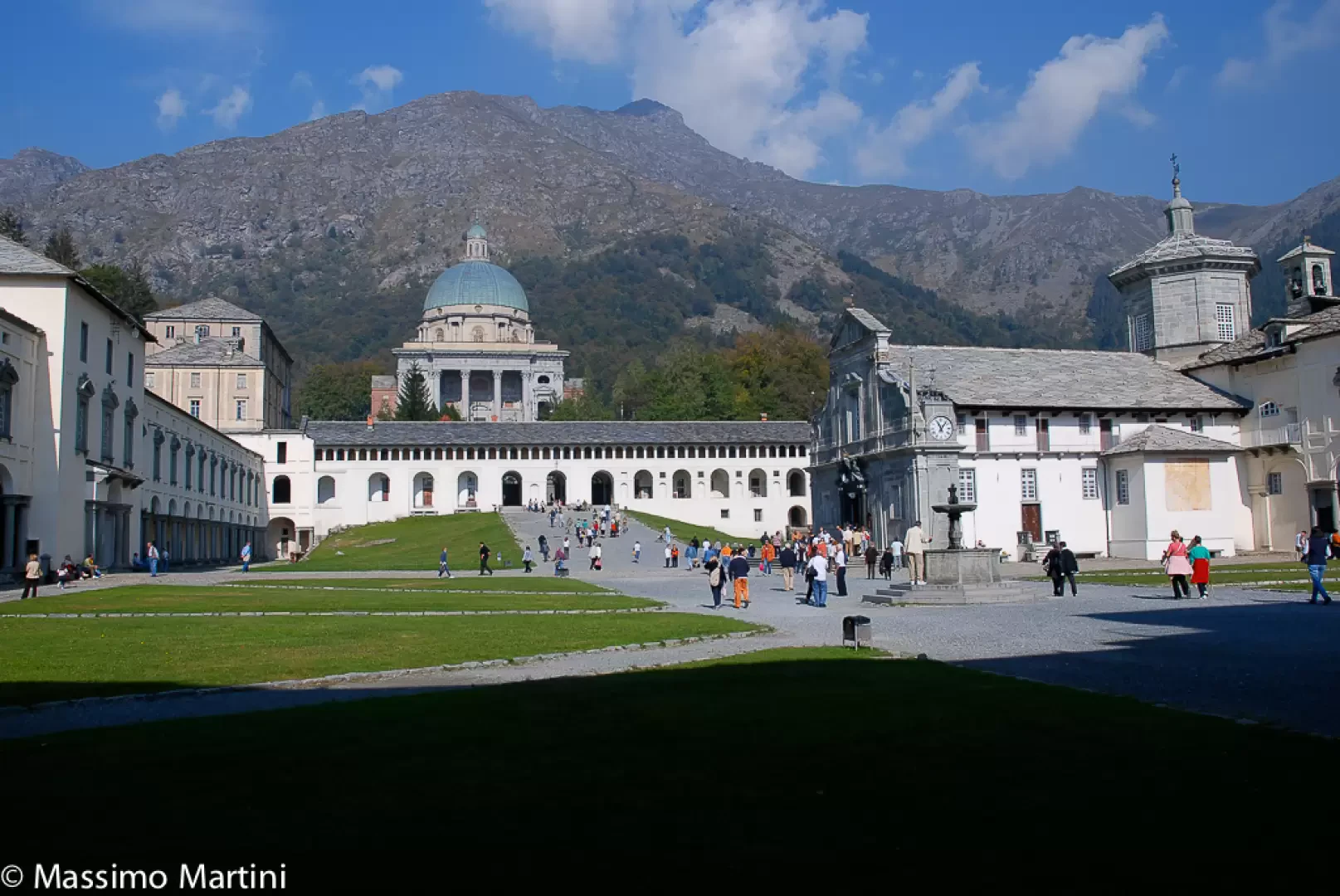
The Sanctuary was enlarged over the centuries until it took on its current structure; the gallery of votive offerings, the library, the museum and the royal flat, where the Savoy family used to stay when visiting the Sanctuary to which they were devoted, the exhibition of cribs, the New Church, are all remarkable. Outside the Sanctuary, the Monumental Cemetery also has stupendous works of art and the tombs of Quintino Sella and many other characters linked to Biella's history, families of wool entrepreneurs and the daughters of Mary, religious nuns at the service of the Sanctuary. On the roof of the south wing that surrounds the basilica there has been the Meteorological and Seismic Observatory since 1972, which still functions today.
Noteworthy at the Sanctuary are the façade by Juvarra, who also designed the throne for one of the Virgin's coronations, and the Burnel, a fountain in the middle of the old church square, the upper part of which comes from the Gaglianico Castle.
Around the Sanctuary from 1620, probably in place of existing pillars, 19 chapels were built, each with a theme, twelve illustrating episodes in the life of the Madonna.
Information
External links