Fossano

Edited by:
Massimo Martini
Access
Fossano can be reached via the motorway network through the exit of the same name on the Turin–Savona [A6] motorway, situated a short distance from the town centre. The Santa Vittoria state road runs through the area via a dual-carriageway bypass that avoids the town centre; from the Fossano Nord toll booth, the provincial road branches off towards Savigliano and Turin, whilst from the Fossano Centro toll booth, the provincial road leads towards Villafalletto. The Colle di Nava state road originates in the main town, heading south to the city of Mondovì and continuing towards the Ligurian coast. Rail services are provided from Fossano station, operated by Trenitalia (TI) under a service contract with the Piedmont Region: the station is situated at the junction between the Turin–Savona railway line and the Fossano–Cuneo–Limone–Ventimiglia railway line, with services running every half hour on weekdays; it is also a stop on the Turin Metropolitan Railway Service (SFM7). Local public road transport is operated by the Granda Bus Transport Consortium. The main airport for the area is Cuneo-Levaldigi Airport, situated in the municipality of Savigliano, approximately 12 km from Fossano.
Introduction
Fossano is a municipality in the upper Cuneo plain, situated on a natural terrace on the left bank of the Stura di Demonte, some twenty-five kilometres from the provincial capital. The area is predominantly flat, in a location that has historically facilitated control of the transport routes between Piedmont and Liguria. The fourth-largest municipality in the province by population, Fossano borders Bene Vagienna, Centallo, Cervere, Genola, Montanera, Salmour, Sant’Albano Stura, Savigliano, Trinità and Villafalletto. Its official foundation dates back to 7 December 1236, when a league of Guelph municipalities at odds with Asti chose the terrace overlooking the River Stura to build a new town; the village was subsequently ruled by the House of Acaia — to whom we owe the castle that still dominates the town’s skyline — and later by the House of Savoy, who granted it city status in 1566. Among the seven main towns in the province, known locally as “the seven sisters”, Fossano stands out for its significant confectionery industry and for its medieval historic centre with Baroque influences.
Description
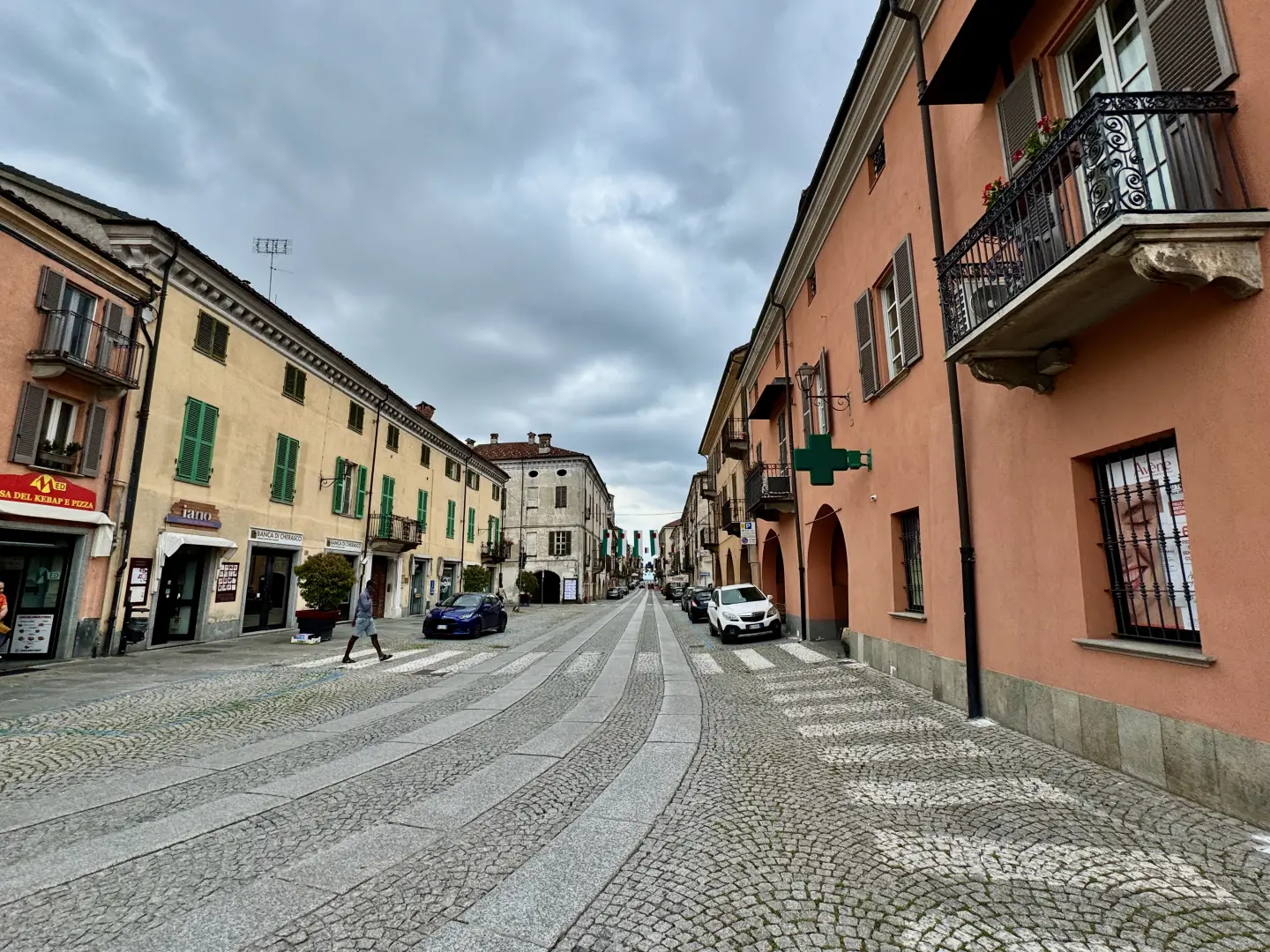
The municipal area extends across the alluvial terrace on the left bank of the Stura di Demonte, the course of which marks the southern boundary of the town centre. The main town occupies the summit plateau, which rises several tens of metres above the open plain to the north and east. The discovery of ceramic and metallurgical artefacts during restoration work in the historic centre suggests the presence of a settlement predating the medieval foundation, dating back to around 800 BC; its documented history begins on 7 December 1236, when a league of Guelph communes chose the terrace overlooking the Stura to build a town in opposition to Asti. Having declared itself Ghibelline in 1238 under the protection of Frederick II of Swabia, the village passed to the Marquisate of Saluzzo in 1304; in 1314 it was ceded to Prince Philip I of Achaea, who in 1324 began construction of the Castle of the Princes ofAchaea, which was completed in 1332. When the House of Achaea died out in 1418, the castle passed to the House of Savoy and, over the centuries, was used as a ducal residence, a seat of government, a prison and barracks; in 1689, around 1,800 Waldensians were imprisoned there, where they died as a result of the religious persecutions of the period. Today, the building houses the public library and the municipal historical archive. With the granting of city status in 1566 and the establishment of the diocese in 1592, the municipality underwent a series of building projects in the town centre. The Cathedral of Santa Maria and San Giovenale was rebuilt in the Neoclassical style in the 18th century to a design by thearchitect Mario Ludovico Quarini, whilst the medieval bell tower — altered in 1666 by thearchitect from Fossano Giovenale Boetto with the addition of an octagonal belfry — is the only surviving structure from the original complex. The Church of the Holy Trinity, built in the 18th century to a design by Francesco Gallo, is an example of Piedmontese Baroque architecture in the Cuneo area. The town is sometimes credited, subject to reservation, with being the birthplace of the painter Ambrogio da Fossano, known as ‘il Bergognone’, who was active between the late 15th and early 16th centuries. From the 16th to the mid-20th century, the town was home to a small Jewish community, traces of which remain in the place-names of the old ghetto. The local economy is characterised by the presence of large confectionery firms of national importance, producing leavened baked goods and festive treats, and by a traditional craft sector linked to wrought iron and woodworking. The Palio dei Borghi with the Giostra dell’Oca — held on the penultimate weekend of June — revives the competition between the town’s seven districts through a re-enactment of medieval origins. The plain, crossed by the Stura di Demonte, offers space for nature trails along the riverbanks and routes suitable for cycling.
Information
General information
Area: 130.14 km²
Altitude of the main town: 375 m
Highest point: 429 m – [to be completed: the maximum elevation recorded by ISTAT (DTM/NASADEM) does not correspond to a place name identified in the sources; check IGM maps]
Population: 24,157 (as at 1 January 2026)
Name of inhabitants: Fossanesi
Patron saint: Saint Giovenale
Neighbouring municipalities: Bene Vagienna – Centallo – Cervere – Genola – Montanera – Salmour – Sant'Albano Stura – Savigliano – Trinità – Villafalletto
Province: Cuneo
Region: Piedmont
Country: Italy
Official website: https://www.comune.fossano.cn.it