Matterhorn

Edited by:
Massimo Martini
Access
Italian side: usual starting point from Breuil-Cervinia (approx. 2,000 m). Average elevation gain 2,500 m. Recommended period: July–September. Challenges: exposure, equipped sections, potential rockfall, glacial terrain in the upper section.
Swiss side: start from Zermatt with access to the Hörnli Hut. Average elevation gain 1,200–1,600 m depending on the lifts used. Recommended period: stable summer weather. Difficulties: seasonal crowds, exposed sections on smooth rock.
In winter, the ascent requires stable snow and weather conditions and comprehensive mountaineering skills on mixed terrain.
Ascent routes
Italian standard route – Cresta del Leone (AD)
A historic route, running along rock with equipped sections and exposed passages.
Swiss standard route – Hörnli Ridge (AD)
The most popular route, running along a mixed ridge with fixed ropes at key points.
North Face (D)
Classic routes and variants on mixed terrain of high difficulty.
Zmutt Ridge (D)
A less frequently used route, running along the western ridge.
Furggen Ridge (D)
A complex and discontinuous route, rarely completed in its entirety.
Traverses and linked ascents
The complete traverse between the Cresta del Leone and the Hörnli Ridge has been documented.
A link-up with the Dent d’Hérens via the Colle del Leone is possible, but is reserved for experienced mountaineers on glacial terrain.
Stops
Bossi Bivouac
Duca degli Abruzzi Hut at Oriondé
Hörnli Hut
Introduction
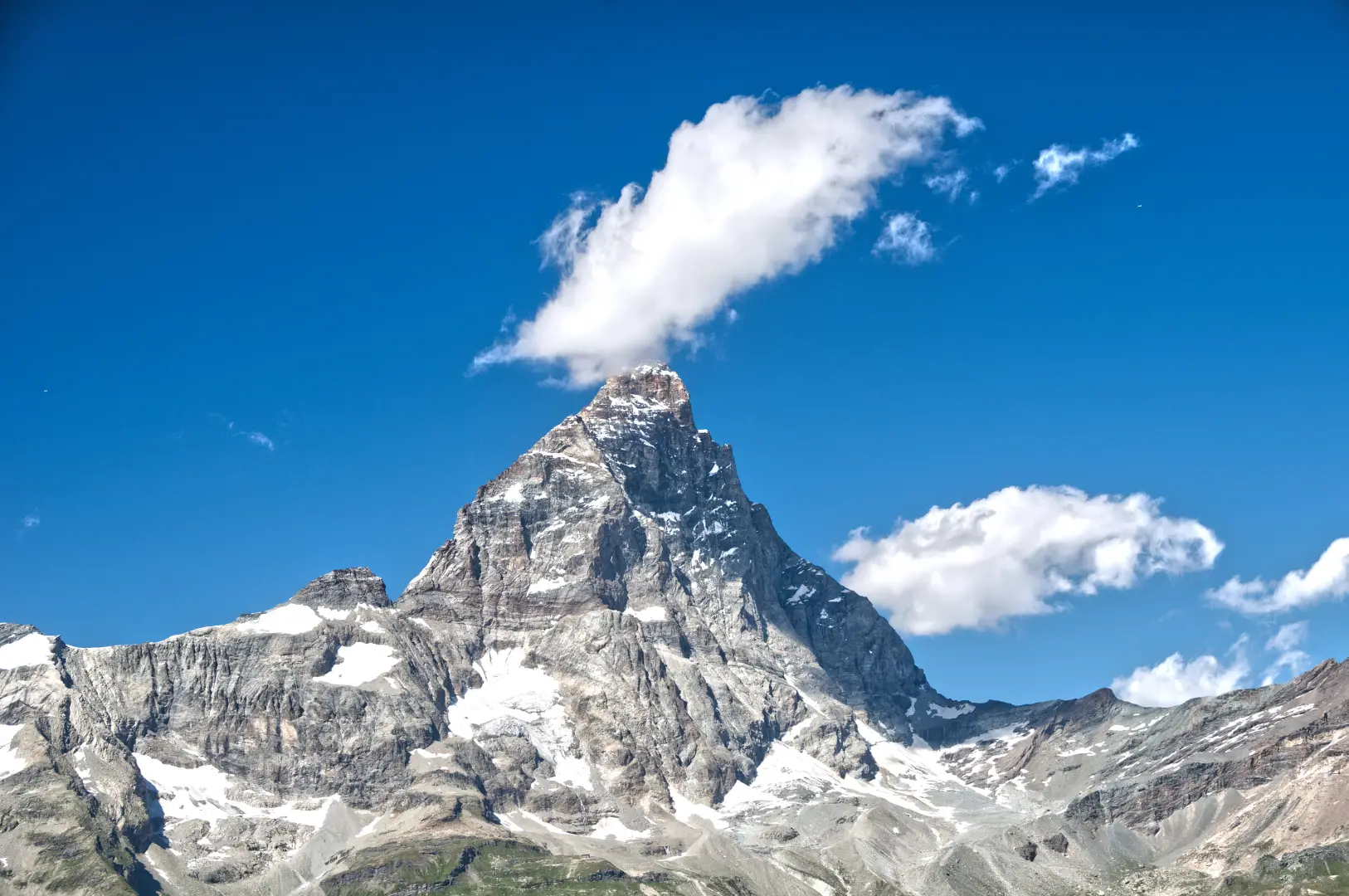
The Matterhorn (4,478 m) rises along the border between Italy and Switzerland, forming one of the most distinctive landmarks in the western Alps. Part of the Dents d’Hérens-Matterhorn Group in the Pennine Alps, it overlooks the Valtournenche valley to the south and the Mattertal valley to the north.
The mountain is characterised by its isolated pyramidal structure, with four main ridges (Hörnli, Leone, Zmutt, Furggen) converging at the summit. This configuration has made it, since the mid-19th century, a prime objective of classical mountaineering, becoming one of the symbols of the golden age of Alpine exploration.
The first ascent on 14 July 1865, led by Edward Whymper, marked a watershed in the history of European mountaineering, both for the technical difficulty of the feat and for the accident that occurred during the descent. Since then, the Matterhorn has remained a testing ground for technical development, from the classic ridge routes to the direct routes up the north face.
Description
The Matterhorn is an isolated pyramid rising from a complex glacial base. The faces each have distinct characteristics:
North (Switzerland): an imposing, triangular face, furrowed by gullies and rocky ridges, historically the scene of highly challenging routes.
East (Hörnli): an articulated ridge forming the standard Swiss route.
South (Leone): a more jagged and complex ridge, the historic Italian approach.
West (Zmutt): a severe, less-frequented face, featuring a mix of rock and ice.
The geological structure consists of metamorphic rocks belonging to the Dentblanchian Formation, which was overlain by deeper units during the Alpine orogeny. This overlying of strata contributes to the colour and structural differences visible on the slopes.
The first ascent
On 14 July 1865, Edward Whymper reached the summit via the Hörnli Ridge together with Lord Francis Douglas, Charles Hudson, Douglas Robert Hadow and the guides Michel Croz, Peter Taugwalder (father and son). During the descent, Hadow fell, dragging Croz, Hudson and Douglas down with him. The rope snapped between Douglas and Taugwalder; Whymper and the Taugwalders returned to Zermatt.
Three days earlier, a party led by Jean-Antoine Carrel had attempted the ascent from the Italian side along the Cresta del Leone, but turned back just below the summit. The incident marked one of the most famous rivalries in nineteenth-century mountaineering.
Development of mountaineering
17 March 1882: first winter ascent by Vittorio Sella with Jean-Antoine Carrel, Jean-Baptiste Carrel and Louis Carrel.
1931: first ascent of the north face by the Schmid brothers, a benchmark route on mixed terrain.
Second half of the 20th century: opening of direct routes and variants on all sides, with a gradual increase in technical difficulty.
Today, the Matterhorn is mainly climbed via the two standard ridges (Hörnli and Leone), both classified as AD in terms of mountaineering difficulty, with Grade III passages and equipped sections. Rock and ice conditions vary depending on recent climatic changes, with greater instability in certain sections of the Lion’s Ridge.
Information
Elevation: 4,478 m
Alternative names: Matterhorn, Gran Becca, Mont Cervin
Mountain range: Dents d’Hérens-Cervino
First ascent: 14 July 1865
First ascenders: Edward Whymper, Lord Francis Douglas, Charles Hudson, Douglas Robert Hadow with the guides Michel Croz and Peter Taugwalder (father and son)
First winter ascent: 17 March 1882
First winter ascenders: Vittorio Sella, Jean-Antoine Carrel, Jean-Battista Carrel, Louis Carrel