Augstbordpass

Edited by:
Massimo Martini
Access
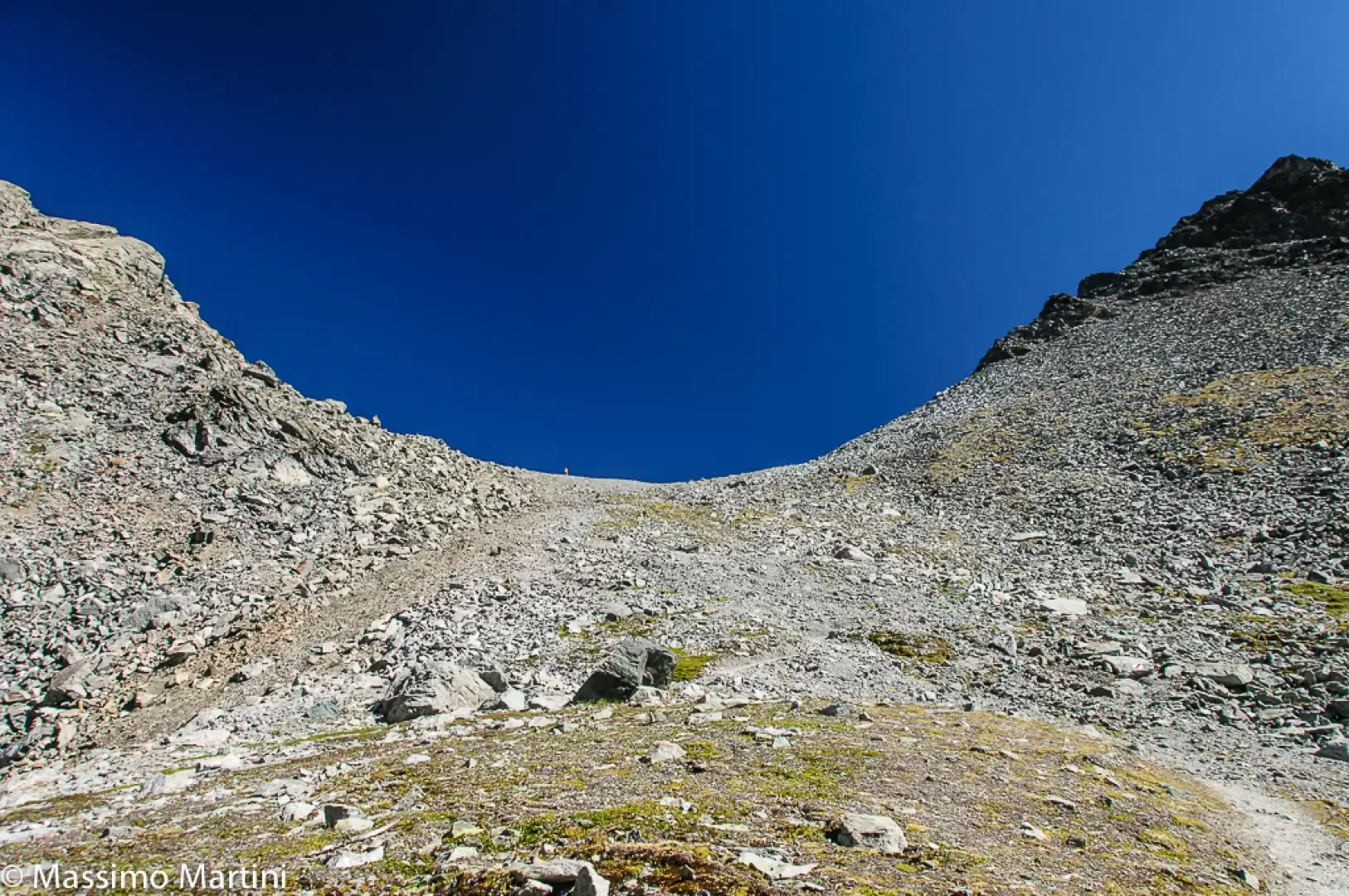
Augstbordpass is accessible from both sides on a well-marked trail with no technical difficulty. The western approach, climbing from Gruben/Meiden, is the most frequented by Walker's Haute Route trekkers and follows a progressive route through pastures, larches and finally scree, with the main elevation gain concentrated in the final third before the saddle. The eastern approach, coming from Jungen via cable car from St. Niklaus, is steeper in the upper section and descends over loose scree; the descent from Jungen to St. Niklaus can be completed partly by cable car, saving approximately 800m of descent. Residual snow may persist on shaded slopes until late June. No fixed ropes or aided sections are present. In winter the pass is not frequented; the Turtmanntal road to Gruben remains closed to vehicles until late spring.
Summer approaches
Western flank (Turtmanntal)
» from Gruben/Meiden (1,818m) – EE – 3h00' – (1,075mD+)
Eastern flank (Mattertal)
» from Jungen (1,968m) – EE – 2h30' – (no route on inalto.org) » from St. Niklaus (1,127m) via cable car to Jungen then trail – EE – 3h30' – (925mD+ from Jungen)
Introduction
Augstbordpass opens at 2,893m on the ridge dividing the Turtmanntal from the Mattertal in the Swiss canton of Valais, at the heart of the Alpi del Weisshorn e del Cervino, a sub-section of the Pennine Alps. The pass separates the western flank dominated by the plateau of Gruben/Meiden (1,818m) — a summer-only hamlet of the municipality of Oberems, deep in the Turtmanntal — from the eastern side descending towards St. Niklaus and Embd in the Mattertal, the great valley at whose far end Zermatt lies. The ridge hosting the pass runs between the Schwarzhorn (3,201m) to the north and the Steitalhorn (3,164m) to the south, offering from the col an exceptional panorama: to the east the eye takes in the Dom, the highest summit lying entirely within Swiss territory, and the four-thousanders crowning the head of the Mattertal; to the west the glacial basin of the Turtmanntal opens up with the Bishorn and the Weisshorn on the skyline; to the north the Aletsch Glacier and the Bernese summits close the horizon. The pass is a stage on the Walker's Haute Route, the walking traverse from Chamonix to Zermatt that ranks among the great classic treks of the Alps, and constitutes the last major col before entering the Mattertal. Its use dates back to the Middle Ages, when the pass served as a transit route between the fertile Rhône Valley and the southern territories, and it remains today one of the most-travelled gateways into the quiet Turtmanntal.
Description
Augstbordpass sits on the watershed dividing the Turtmänna, a tributary of the Rhône, from the Matter Vispa, which flows towards Stalden and Visp. The pass is wide and open at its upper section, with a rocky and scree-covered saddle bearing no permanent structures. The bdrock is crystalline — gneisses and micaschists typical of the inner Pennine Alps — and glacial landforms are still legible: the Gruben plateau, through which the Turtmänna meanders, is a textbook example of a glacially suspended valley, while the eastern flank presents steep scree slopes left by Quaternary glacier retreat. The summits flanking the pass — Schwarzhorn (3,201m) to the north and Steitalhorn (3,164m) to the south — are accessible by alpine routes, but not from the pass by documented hiking paths. Wildlife is abundant on both sides: chamois, ibex and marmots are regularly reported; the rupicoline avifauna includes the bearded vulture (Gypaetus barbatus), occasionally observed in the Turtmanntal.
The history of Augstbordpass is bound closely to that of the Turtmanntal, one of the most secluded valleys in German-speaking Valais. Historical sources document the pass as a commercial transit route from the Middle Ages: it linked the fertile Rhône plain and the communities of the Turtmanntal with the Mattertal through a network of pastoral and trading exchanges connecting valleys divided by imposing ridges. A distinctive feature of the pass's history is the medicinal spring known as Goldbrunnji, which welled out of a rock face in the Augstbordtälli ravine on the St. Niklaus side between the sixteenth and eighteenth centuries. The spring water, which stained the surrounding rocks yellow, was held to be effective against fevers, dropsy, eye conditions and breathing difficulties, and drew visitors from well beyond the regional borders. The spring disappeared — for reasons not fully established, possibly a seismic event or a decline in belief in its curative properties — and is no longer visited by pilgrims. The pass's function as a communication route between the Turtmanntal and the Mattertal remained active into the twentieth century, when increasing motorisation reduced foot traffic to the level of recreational hiking and mountaineering.
The toponym Augstbord is of Alemannic origin, composed of Augst (August, the month of high-altitude pasturing) and Bord (edge, rim of a terrace), indicating the upper margin of the summer pastures — a name that encodes in its very linguistic morphology the historical pastoral use of the pass, crossed by herds moving to the high alpages each summer. The place name thus documents, through etymology alone, the pass's function as the threshold between forested terrain and high-altitude grazing land. The Turtmanntal still preserves this character: the summer village of Gruben/Meiden, inhabited only from June to September, remains one of the most intact settings of traditional alpine life in German-speaking Valais, with the Hotel Schwarzhorn — in operation since the 1860s, when the first British tourists arrived — as the main base for visitors to the valley.
Augstbordpass is today one of the best-known passes in German-speaking Valais thanks to its position on the Walker's Haute Route, the walking traverse from Chamonix to Zermatt that is among the world's great classic alpine treks. In the standard fourteen-stage itinerary, the pass is the high point of stage twelve (Gruben–St. Niklaus) and represents the last major col before Zermatt: the descent on the eastern flank offers the first glimpse of the Mattertal and, at the far end, of Zermatt. The pass also appears on the Alpenpässe-Weg n. 6.17 (Grächen–Gruben), one of the itineraries of the Swiss Alpine Passes Trail network. The hiking season runs from July to September; outside this window the Turtmanntal is closed to traffic and trails may be snow-covered.
Traverses
» Alpenpässe-Weg n. 6.17 – stage: Grächen → Gruben (passing over the col) » Walker's Haute Route (Chamonix–Zermatt) – stage 12: Gruben → St. Niklaus
Mountain huts
» Hotel Schwarzhorn, Gruben/Meiden (1,818m)
Information
Height: 2894m
Alternative Name: -
Mountain Group:Elevation: 2,893m [to be verified on SwissTopo: some sources indicate 2,894m]
Mountain group: Alpi del Weisshorn e del Cervino
Alpine chain: Pennine Alps (SOIUSA SZ. 9)
Type: mountain pass
Protected area: none
Municipality/ies: Oberems (VS) – Turtmanntal side; St. Niklaus (VS) and Embd (VS) – Mattertal side
Valley/ies: Turtmanntal – Mattertal
Nation(s): Switzerland
Trekking routes: Walker's Haute Route (Chamonix–Zermatt), stage 12; Alpenpässe-Weg n. 6.17
Recommended period: July – September
Aspect of flanks: western flank (Turtmanntal) facing west; eastern flank (Mattertal) facing east
Residual snow: until late June – early July
Fixed ropes / aided sections: no
Structures at the pass: none
Hiking difficulty: EE
Average elevation gain on approach: 1,075m (from Gruben/Meiden)
Collections
Photo gallery
