La Magdeleine

Edited by:
Massimo Martini
Access
La Magdeleine can be reached from the bottom of the Valle d'Aosta valley by taking the motorway as far as the Châtillon-Saint-Vincent exit, from where you continue in the direction of Valtournenche by taking the regional road . After about 7.6 km, you reach Antey-Saint-André, where you turn onto the regional road in the direction of La Magdeleine; the road climbs a further 7.5 km to the main hamlet of Brengon. The municipality is not served by a direct railway connection: the nearest station is Châtillon, on the Turin-Aosta line operated by Trenitalia (TI). The local public transport service is provided by Savda with runs connecting the municipality with Antey-Saint-André and the valley floor; the frequency is reduced and subject to seasonal variations. During the winter period, it is advisable to check the condition of the road, which can only be used with chains or winter tyres during heavy snowfall. A covered parking area is available near the parish church in Brengon.
.Introduction
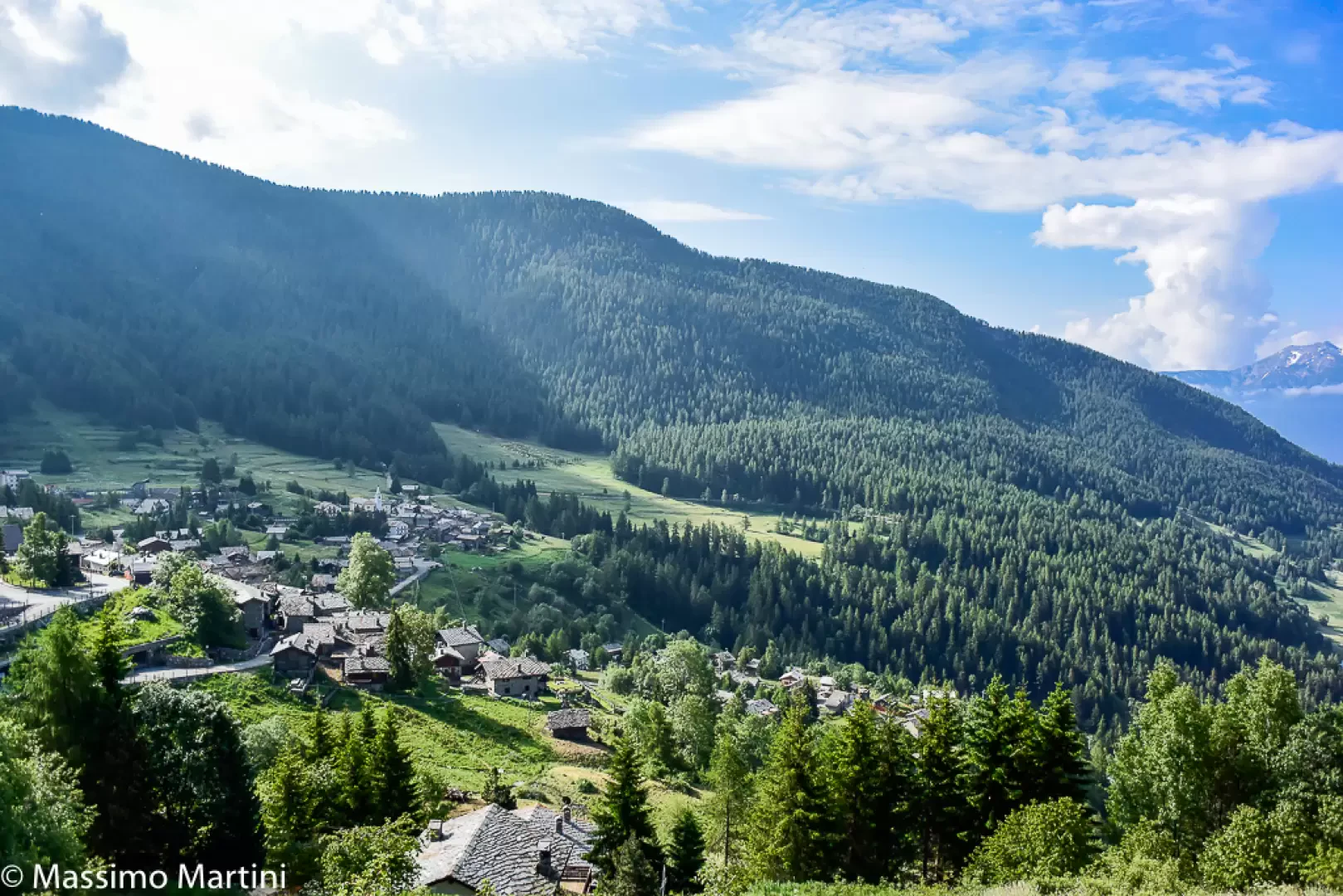
La Magdeleine is a municipality in Valtournenche, a right-hand side valley of the Aosta Valley, located on the left side of the Marmore stream at an altitude of 1,644 metres. The municipality, which is small in size, is entirely mountainous and includes five historic hamlets - Artaz, Brengon, Clou, Messelod and Vieu - scattered along the slope among coniferous forests and high-altitude pastures. It borders the municipalities of Antey-Saint-André, Ayas, Chamois and Châtillon. The origins of the settlement date back at least to the Iron Age, as testified by the finds unearthed at Monte Tantanè. In the Middle Ages, the territory was part of the seigniory of Cly and was aggregated with the community of Antey, from which it separated religiously in 1789 and administratively in 1798. With just over one hundred residents, the municipality is among the least populated in Valle d'Aosta and is part of the Unité des Communes valdôtaines Mont-Cervin.
.Description
The territory of La Magdeleine occupies a mountain slope with a predominantly westerly orientation, with altitudes rising from around 1,450 m in the lower hamlets to the 2,734 m of Mount Tantanè, the highest point of the municipality. The landscape is characterised by an alternation of coniferous forests in the lower areas and alpine pastures in the higher areas; the Champlong alpine pasture lakes still contain the remains of large submerged coniferous trunks, probably the last vestige of a large forest that was eliminated over the centuries to make room for forage meadows.
Human presence in the area has been documented since the Iron Age: excavations carried out at the base of Mount Tantanè have brought to light artefacts that can be traced back to a stable settlement of the Salasse people, with elements suggesting a connection with mining activities linked to the nearby gold deposit. In the Middle Ages, the village was known as Mont de Vieu and belonged to the seigniory of Cly, which held control until 1376 when Peter II of Cly was stripped of the fiefdom by the Savoy. The seigniory subsequently passed through several hands - including Cristoforo de Morales and Jean Fabri, Secretary of State - until Pierre Philibert Roncas in the 17th century, a member of one of the most influential families in Valle d'Aosta at that time. Ecclesiastical separation from Antey was obtained in 1789, after a request made as early as 1748 on the grounds of the distance from the main parish church, which was particularly problematic in the winter months; the autonomous parish was dedicated to Santa Maria Maddalena, the place-name that gives today's municipality its name.
The traditional economy was based on subsistence farming and cattle and sheep breeding. Families moved seasonally between the Châtillon plain, where they tended vines in spring and autumn, and the mountain of La Magdeleine, where they spent most of the year growing cereals and producing milk, butter and cheese. Woodworking was also widespread for the production of tools and utensils, including the characteristic sabots. Viticulture developed between 550 and 850 m above sea level and was centred on the petit rouge grape variety, with gamay and pinot noir also present. Local traditions include the Bataille des Reines, a competition between cows of the Aosta Valley breed for which a regional championship has been established since 1957.
The municipality's built heritage includes the Parish church of Saint Mary Magdalene in Brengon, built in 1774 with subsequent 19th-century transformations, and two chapels: the Chapel of Saints Rocco and Sebastian in Messelod, founded in 1672 and decorated on the façade with three devotional paintings, and the Chapel of Our Lady of the Snow in Vieu. Among the structures of historical interest are eight water mills distributed between the hamlets of Brengon and Clou, aligned along a stream and fed by a system of wooden channels known as troccoli; attested at least since the 18th century, they were used to grind wheat for black bread. Five of them have been recovered and the path connecting them can be visited, with access to the interiors by appointment. Also widespread in the area are rascards, wooden structures traditionally used as barns, and greniers, constructions for storing cereals.
Because of its soft mobility-oriented approach, the municipality is a member of the Perle delle Alpi consortium. The local footpath network connects with the Valtournenche routes and provides access to the alpine pasture areas and the upper reaches of the territory. Excursion possibilities include routes along the ru, ancient open-air irrigation channels that cross forests and meadows, and winter snowshoe outings; the area also has a small ski lift serving skiing activities.
Information
General Data
Area: 8.94 km²
Main elevation: 1,644m
Main elevation: 2,734m - Monte Tantané
Number of inhabitants: 108 (as of 28.02.2026)
Name in dialect: La Madélène (Franco-Provençal)
Name of the inhabitants: madeleins
Patron Saint: Saint Mary Magdalene
Border municipalities: Antey-Saint-André - Ayas - Chamois - Châtillon
Province of origin: -
Region of origin: Valle d'Aosta
Nationality: Italy
Institutional site: https://www.comune.la-magdeleine.ao.en